
Table of Contents
ToggleTractor Oil Filters: Find the Right Fit Fast | Best Air Filter
By Neeraj Goel, filter manufacturer with 10+ years of experience in industrial and automotive filtration specialist at Best Air Filter.
Wrong filter, wrong engine hours, or wrong micron rating and you’re not saving money. You’re setting up a repair bill.
Tractor engines run under heavier and longer loads than car engines. Dust, soot, and metal particles build up in the oil faster. The filter is the only thing standing between that debris and your bearings, cylinder walls, and camshaft. Get the fit wrong, or leave it in too long, and the damage shows up in engine hours, not miles.
This guide covers how to pick the right filter, compare the main brands, and install it correctly. It also explains why the wrong choice matters more on a tractor than on a car.
Why fitment matters more than price
A tractor oil filter has one job: trap contaminants before they reach moving parts. Three specs decide how well it does that job.
Micron rating
Sets the smallest particle size the filter can catch. Diesel tractor engines produce more soot than gasoline car engines, so most manufacturers spec finer filtration, often in the 20 to 25 micron range for full-flow filters. Independent lubrication industry testing shows economy-grade filters often only reach 95 percent capture efficiency at 40 microns, well above what a diesel engine needs. A filter built for a car engine may not catch enough of what a diesel tractor engine produces, and our car oil filter guide covers why that gap matters even outside tractors.
Bypass valve pressure
Controls what happens when the filter clogs. Once resistance builds past a set point, the valve opens and lets oil flow around the filter media, unfiltered, rather than starve the engine. Most quality filters open this valve somewhere between 8 and 30 psi differential, according to filter industry technical documentation. If that pressure setting is off from what your engine maker specifies, you either get unfiltered oil circulating too often, or the engine risks oil starvation on a cold start.
Housing size and thread pattern
Decide whether the filter physically fits. Two filters can look almost identical and still not be interchangeable, because the thread pitch or gasket diameter is different.
None of these specs are visible from the outside of the box. That’s why cross-referencing your tractor’s exact model and engine series against a verified part number matters more than picking whatever filter is cheapest or most available.
Shop by brand or model first
Before comparing filter types, confirm your tractor’s make, model, and engine series. John Deere, Kubota, Massey Ferguson, New Holland, and Case IH each use filter part numbers tied to specific engine builds, not just the tractor model name. You can see this pattern directly on John Deere’s own filters page, which lists separate engine oil, air, and hydraulic filter lines rather than one universal part. Two tractors with the same model number can carry different engines depending on the year, and that changes which filter fits.
Check your operator’s manual or the engine data plate before you order. If you’re not sure which filter your tractor takes, get the model and engine hours confirmed before buying. Buying based on filter shape alone is one of the most common fitment mistakes, because spin-on filters from different brands can look nearly identical while using different thread sizes.
Filters for popular Indian tractor brands
If you’re running a Mahindra, Sonalika, Swaraj, Eicher, or Farmtrac tractor, the fitment logic above still applies, but part numbers follow each manufacturer’s own naming pattern. A few examples to show what correct fitment looks like in practice:
Mahindra
Oil filters vary by series. Older models like the 475 DI and 595 DI use a different filter than newer Arjun or Yuvo tractors, and Mahindra also splits filters by “oldest model” and “latest model” tractor generations. A part number like 006016642V91 is specific to one engine series, not the whole Mahindra range.
Swaraj
Genuine engine oil filters are commonly rated by service hours, such as a 400-hour filter for latest-model tractors. The same tractor name can take a different filter depending on whether it’s an older regular model or a current one.
Sonalika
Filters differ by engine size too. A 60 HP model’s hydraulic lift filter isn’t the same as the filter for a 3-cylinder Garden Track model, even within the Sonalika range.
Eicher and Farmtrac
Both use separate filter assemblies for engine oil, air intake (primary and secondary), and hydraulic lift systems, so a single “Eicher filter” search usually isn’t specific enough to guarantee fitment.
The pattern across all of these: brand name alone never confirms fitment. You need the engine series, model year, and ideally the part number stamped on your current filter or listed in your operator’s manual. If you’re ordering online, check that the listing states which specific model and hour-rating the filter covers, not just the tractor brand.
Spin-on vs cartridge filters
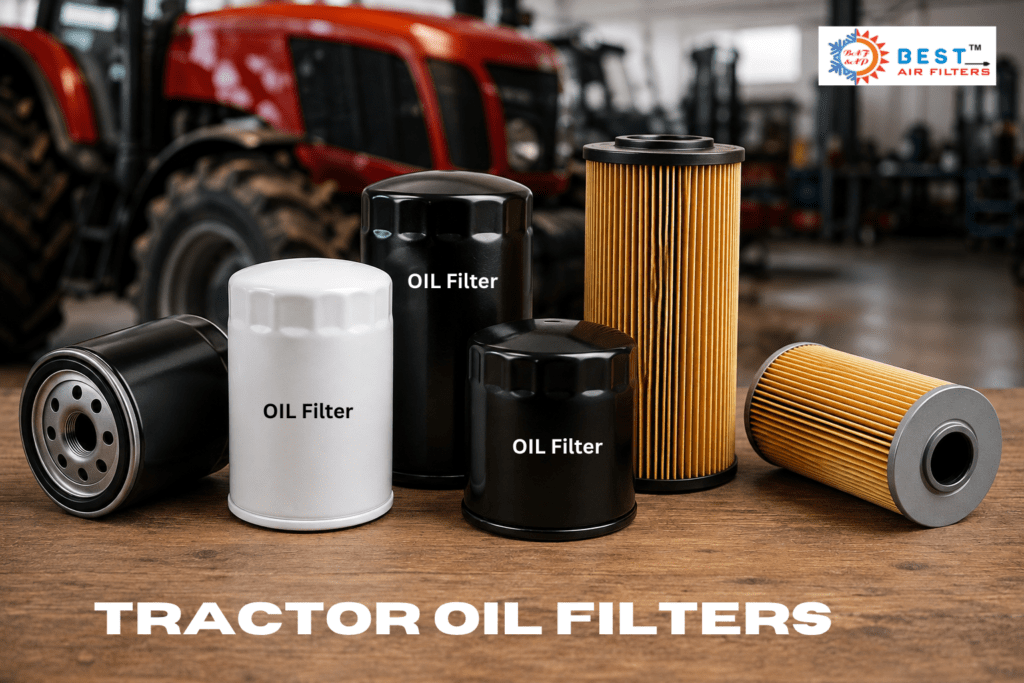
Tractor oil filters come in two main types.
Spin-on filters
A self-contained metal canister that threads onto the engine block. You remove the whole unit and replace it with a new one. This is the most common type across tractor engines built in the last few decades, and it’s the simplest to service in the field.
Cartridge filters
Use a replaceable filter element inside a permanent housing on the engine. Only the element gets replaced, not the housing, which produces less waste per service. Newer diesel engines are shifting toward cartridge designs, partly for that reason.
Neither type is universally better. The engine determines which one you need, and most tractors aren’t built to accept both.
Comparing the main brands
| Brand | Filter type | Best for | Notes |
|---|---|---|---|
| OEM (John Deere, Kubota, etc.) | Spin-on and cartridge | Warranty-period tractors | Highest cost, guaranteed exact spec |
| Mahindra, Swaraj, Sonalika, Eicher (OEM) | Spin-on | Indian-market tractors | Genuine parts tied to specific engine series, not just model name |
| Baldwin | Spin-on and cartridge | Heavy-duty and ag use | Established reputation in agricultural filtration |
| Donaldson | Spin-on and cartridge | Dusty or high-debris conditions | Known for advanced filter media |
| WIX | Spin-on | General tractor use | Wide cross-reference coverage |
| Napa Gold | Spin-on | Budget-conscious OEM alternative | Built to OEM-comparable specs |
| Fram | Spin-on | Light-duty and compact tractors | Widely stocked, suited to lighter-use machines |
How often to change the filter
Most manufacturers recommend replacing the oil filter at every oil change, typically every 100 to 200 engine hours. The exact interval depends on the model and how the tractor is used. Heavy field dust, high ambient temperatures, or continuous heavy load can shorten that interval.
Check your operator’s manual for the manufacturer’s number, and don’t stretch the interval to get more use out of one filter. A clogged filter forces the bypass valve open more often, which means the engine runs on unfiltered oil for longer stretches than it should.
Installing a new oil filter
- Run the engine briefly to warm the oil, then shut it off and let it settle for a few minutes.
- Place a drain pan under the filter before removing it. Expect some oil to spill during removal.
- Loosen the old filter counterclockwise, using a filter wrench if it’s seated tight.
- Check that the old gasket came off with the filter. A gasket stuck to the mounting surface is a common cause of leaks after the swap.
- Wipe the mounting surface clean.
- Coat the new filter’s gasket lightly with clean oil before installing it.
- Hand-tighten the new filter, typically three-quarter to one full turn past the point where the gasket first contacts the surface. Check your engine’s torque spec rather than guessing.
- Refill with the correct oil grade and quantity, run the engine briefly, and check for leaks around the new filter.
FAQs
What’s the difference between OEM and aftermarket tractor oil filters?
OEM filters are made or specified by your tractor’s manufacturer and match exact engine specs. Aftermarket filters from established brands can match or exceed OEM performance for less money, but quality depends on the specific brand.
How often should I change my tractor’s oil filter?
Most tractors need a filter change every 100 to 200 engine hours, tied to the oil change interval. Confirm the exact number in your operator’s manual.
Can I use a car oil filter on a tractor?
Not usually. Even if the thread size happens to match, car filters are typically rated for lower soot loads and different bypass pressures than diesel tractor engines produce.
What micron rating do diesel tractor engines need?
It varies by engine, but diesel tractor engines generally need finer full-flow filtration than gasoline car engines. Check your engine manufacturer’s spec sheet for the exact number.
Does a more expensive filter always mean better protection?
Not automatically. Price often reflects brand and distribution costs as much as filter quality. A mid-priced filter from a manufacturer with published specs and a track record in agricultural equipment can outperform a premium-priced filter with no available spec sheet. Check the numbers, not just the price tag.
Do Mahindra, Sonalika, or Swaraj tractors need a different filter than John Deere or Kubota?
Yes, in the sense that each manufacturer assigns its own part numbers, even when the physical filter type (spin-on or cartridge) is similar. A Mahindra Arjun filter won’t fit a Sonalika 60 HP model, and an older Mahindra 475 DI takes a different filter than a newer Yuvo. Always match by engine series and part number, not by tractor brand alone.
Reading a filter spec sheet
Most buyers skip the spec sheet and go straight to the price tag. That’s where fitment mistakes start.
A proper spec sheet lists thread size and pitch, gasket outer diameter, filter height, micron rating, bypass valve opening pressure, and anti-drainback valve presence. Anti-drainback valves keep oil in the filter housing when the engine shuts off, so the next startup doesn’t run dry for a few seconds before oil pressure builds. Not every filter has one, and skipping it on an engine that expects one can cause dry-start wear over time.
If a listing doesn’t publish these numbers, or only shows a photo and a price, that’s a sign to look elsewhere or confirm fitment directly with the seller before ordering.
Running a mixed-brand fleet
Farms and contractors running tractors from several manufacturers face a fitment problem that single-tractor owners don’t: keeping track of which filter goes with which machine.
A few practices reduce mistakes here. Keep a written or digital list of each tractor’s exact model, engine series, and correct filter part number, rather than relying on memory or matching by filter shape. Store filters by tractor, not by brand, if your inventory space allows it. And when ordering in bulk from an aftermarket supplier, order enough at once to avoid mixing part numbers between machines that look similar but aren’t.
Mixed fleets are also where counterfeit risk goes up. Buying larger quantities from unverified sellers to save money is exactly the scenario where a bad batch of filters can end up across multiple machines before anyone notices a problem.
Signs your current filter isn't right
A few field signs point to a fitment or spec mismatch, even if the filter physically threaded on without issue.
Oil pressure that drops noticeably right after a filter change can mean the bypass valve is opening too early, which usually points to a mismatched pressure rating. Metal particles or excessive sludge in the oil at the next change, despite following the correct interval, can mean the micron rating is too coarse for the engine’s needs. And a filter that leaks at the gasket shortly after install, assuming it was torqued correctly, often means the gasket diameter doesn’t match the mounting surface exactly, even if the threads caught.
None of these are common with a correctly matched OEM or verified aftermarket filter. They show up more often when a filter was chosen by thread size alone, without checking the full spec sheet against the engine’s requirements.
Related parts worth checking
While you’re replacing the oil filter, check a few related parts at the same time: engine oil matched to your climate and filter, drain plug gaskets, and hydraulic filters if your tractor is due for one. Hydraulic filters get overlooked often, but they matter just as much to system longevity. If your tractor also runs in dusty field conditions, it’s worth checking the air intake side too, since a clogged air filter puts extra strain on the same engine your oil filter is protecting. For automotive-style filtration questions beyond tractors, our automotive filters overview covers the broader category.
How this guide was put together
Who: this guide was written by our filtration team at Best Air Filter, based on manufacturer spec sheets, cross-reference data, and field feedback from customers running mixed tractor fleets.
How: the specs above (micron ratings, bypass pressure ranges, service intervals) come from published engine manufacturer documentation, not estimates. Where a number varies by model, we’ve said so rather than giving a single figure that might not apply to your tractor. Parts of this page were drafted with AI assistance and reviewed and edited by our team before publishing.
Why: fitment mistakes on tractor oil filters lead to real engine damage, not just inconvenience. The goal here is to give you enough information to buy the right part the first time, not to rank for a keyword.
If anything above doesn’t match your specific tractor model, check your operator’s manual or contact us with your model and engine hours, and we’ll help confirm the right part before you buy.