
Table of Contents
ToggleBest Pharmaceutical Filters Manufacturer in Delhi, India.
Written by Neeraj Goel, Founder, Best Air Filter . 10+ years of experience manufacturing HVAC and industrial air filters in Delhi.
A pharmaceutical plant can have the best equipment, the best raw materials, and the best trained staff, and still fail a batch because the air in the room wasn’t clean enough. That’s what makes pharmaceutical filters different from ordinary industrial air filters. They don’t just protect equipment. They protect the product, the patient, and the manufacturing license.
This guide covers what pharmaceutical filters do, the cleanroom standards that decide which filter grade you need, the types of filters used in pharma HVAC systems, and what Indian manufacturers need to know under Schedule M. You can see our full filtration range on the Best Air Filter homepage.
What are pharmaceutical filters?
Pharmaceutical filters are air filtration components fitted inside HVAC systems and cleanroom air handling units to control particle contamination during drug manufacturing. They remove dust, microbes, and airborne fibers before air reaches production, filling, and packaging areas.
Unlike a factory or warehouse filter, a pharmaceutical filter has to meet a documented cleanliness target, not just “clean enough.” Regulators check this target during inspection. A filter that isn’t rated, tested, and logged correctly can hold up a plant’s manufacturing license.
Why pharma needs a different filtration standard
General industrial filtration protects machines from dust. Pharmaceutical filtration protects the product from contamination that could make a batch unsafe or non-compliant.
A few specific risks drive this:
- Cross-contamination between products. Airborne particles from one drug can carry into another product line if filtration and airflow direction aren’t controlled.
- Microbial contamination. Sterile products such as injectables need air that’s essentially free of viable organisms, not just dust.
- Batch rejection. A single failed particle count during environmental monitoring can mean scrapping an entire batch.
- Regulatory action. Inspectors from CDSCO, USFDA, or WHO can flag HVAC and filtration gaps during audits, and repeated deficiencies can suspend a manufacturing license.
This is why pharmaceutical filters are specified, tested, and documented differently from the filters used in a general manufacturing plant.
Cleanroom classification: the standard that decides your filter grade
Every pharmaceutical cleanroom is built to a specific air cleanliness class, and that class decides which filter grade goes into the HVAC system.
The global reference is ISO 14644-1, which defines air cleanliness in 9 classes, ISO Class 1 being the cleanest and ISO Class 9 the least clean. Pharmaceutical manufacturing typically operates across ISO Class 5, 7, and 8, which line up with EU GMP Grades A through D:
- Grade A (ISO 5): critical zones such as filling lines for sterile injectables. Air must contain no more than 3,520 particles of 0.5 microns or larger per cubic meter.
- Grade B (ISO 5, at rest): the background environment surrounding Grade A zones.
- Grade C (ISO 7): less critical stages of sterile manufacturing.
- Grade D (ISO 8): general processing areas for non-sterile products.
A facility making oral solid dosage forms like tablets and capsules generally needs Grade D areas. A facility filling injectables needs Grade A/B zones with far tighter filtration and monitoring.
Types of pharmaceutical filters
Pharma HVAC systems rarely rely on one filter alone. Air usually passes through a staged filtration train inside the air handling unit (AHU) before it reaches the cleanroom.
Pre-filters The first stage. Pre-filters trap larger particles, dust, and insects from outside air, protecting the finer filters downstream from early clogging. They’re rated around G4 to MERV 8 and need frequent replacement since they load up fastest.
Fine filters The second stage, typically rated F7 to F9 or MERV 13 to 16. Fine filters remove smaller particles the pre-filter missed and extend the life of the HEPA filter that follows.
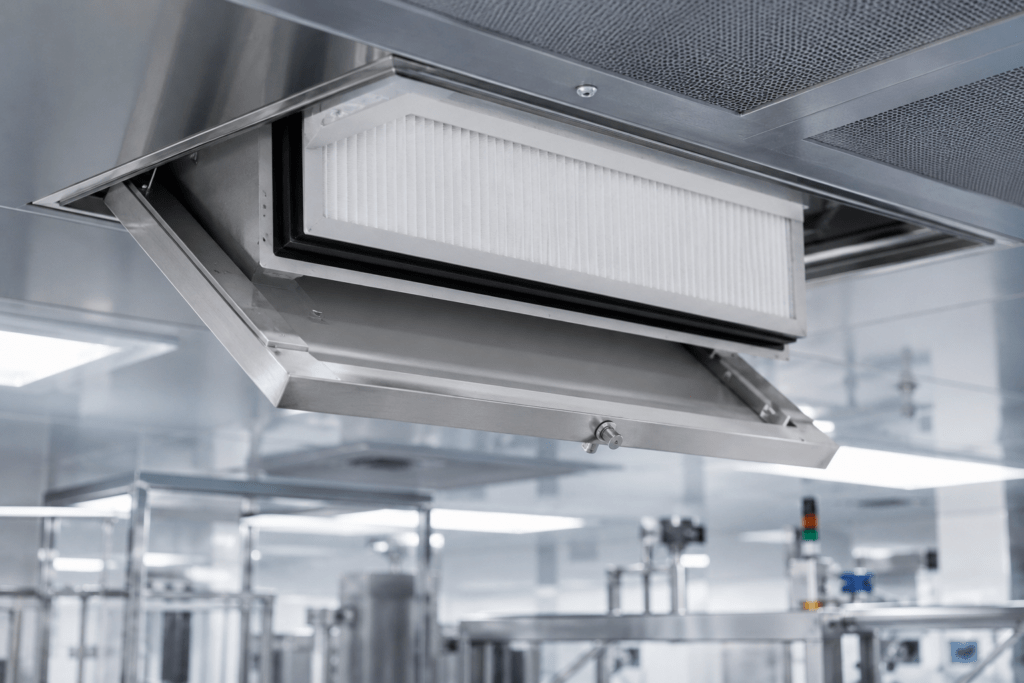
HEPA filters The final and most critical stage for cleanrooms. HEPA (High-Efficiency Particulate Air) filters are rated H13 or H14 under EN 1822, capturing 99.95% to 99.995% of particles at the most penetrating particle size. HEPA filters are usually installed as terminal filters at the point where air enters the cleanroom, mounted in the ceiling grid directly above the work zone.
ULPA filters Used in the most sensitive Grade A zones, ULPA (Ultra-Low Penetration Air) filters go a step beyond HEPA, capturing 99.999% of particles at 0.12 microns. Not every pharma line needs this grade, and using ULPA where HEPA is sufficient adds cost without real benefit.
Airflow design in pharmaceutical cleanrooms
Filter grade alone doesn’t guarantee a clean environment. Airflow direction and pressure control matter just as much.
Laminar airflow moves air in parallel streams at a constant velocity, sweeping particles away from the work zone rather than letting them circulate. Grade A zones almost always use unidirectional (laminar) airflow directly over the critical process.
Pressure cascades keep cleaner rooms at higher pressure than adjacent, less clean areas, so air always flows from clean to less clean, never the other way. For containment of hazardous or potent compounds, this is reversed. The containment room runs at negative pressure so nothing escapes into surrounding areas.
Getting this wrong is a common inspection finding. A room with the correct filter grade but the wrong pressure cascade can still fail environmental monitoring.
Pharmaceutical filters and India's revised Schedule M
India’s pharmaceutical GMP requirements are set under Schedule M of the Drugs and Cosmetics Rules, administered by CDSCO. The revised Schedule M pushes Indian facilities closer to WHO-GMP and EU-GMP expectations, and it specifically calls out ISO 5/7/8 cleanroom classification aligned with EU GMP Grades A through D, along with validated HVAC systems and HEPA filtration meeting documented leak test criteria.
For manufacturers this means HVAC and filtration can no longer be a one-time installation. It has to be qualified (IQ/OQ/PQ), monitored continuously, and re-validated on a schedule, with records available for inspection. You can check current requirements directly on the CDSCO website, and the WHO’s GMP guidelines for HVAC systems cover the design and qualification principles most Indian facilities are now expected to follow.
Filter testing and maintenance in pharma facilities
Pharmaceutical filters need documented testing, not just visual inspection.
HEPA integrity testing (DOP/PAO test). A challenge aerosol is introduced upstream of the filter, and a photometer scans downstream for leaks around the filter frame or media. This confirms the filter and its seal are intact, not just that the media itself is rated correctly.
Differential pressure monitoring. Gauges track the pressure drop across each filter stage. Rising pressure drop signals a loading filter that needs replacement before it restricts airflow enough to affect room classification.
Particle count monitoring. Regular particle counts in the room confirm the space is holding its classified grade during actual operation, not just at rest.
Replacement schedule. Pre-filters typically need replacement every 1 to 3 months depending on outdoor air quality. Fine filters generally last 6 to 12 months. HEPA filters can run 3 to 5 years if pre-filtration upstream is maintained properly, though integrity testing happens on a fixed annual schedule regardless of visible condition.
Common mistakes in pharmaceutical filtration
A few issues show up repeatedly during facility audits and HVAC reviews:
Treating HEPA as a single spec. “HEPA filter” isn’t one product. H13 and H14 grades perform differently, and using a lower grade than your cleanroom class requires will fail classification even if the filter is genuinely HEPA-rated.
Skipping pre-filtration. Installing HEPA filters without adequate pre-filtration in front of them shortens HEPA life dramatically. A HEPA filter rated for 3 to 5 years can clog within months if it’s catching load that a pre-filter should have stopped.
Ignoring pressure cascade direction. A room can have correctly rated filters and still fail environmental monitoring if air pressure isn’t cascading from clean to less clean zones the way the design intended. Door seals, damaged gaskets, and blocked return air paths are common causes.
Delaying integrity testing. Some facilities treat the annual DOP/PAO test as a formality rather than a real check. A filter can look fine and still have a leak at the frame seal that only a proper scan test will catch.
Buying on price alone. A cheaper HEPA filter without a scan test certificate or documented efficiency rating can cost more in the long run through failed audits, batch rejections, or an inspection finding that shuts down a line until it’s fixed.
How to choose a pharmaceutical filter manufacturer
A few questions are worth asking before you commit to a supplier:
- Does the manufacturer test HEPA filters individually with a scan test certificate, or only sample-test a batch?
- Can they supply filters rated to your specific cleanroom grade, not a generic “HEPA” label?
- Do they provide documentation you can hand directly to CDSCO or WHO-GMP inspectors?
- Can they match housing dimensions to your existing AHU without a full retrofit?
- Do they offer replacement and maintenance support after installation, or just a one-time sale?
A pharmaceutical filter that lacks proper documentation can create more inspection risk than it solves, even if the filter media itself is genuinely high-efficiency.
Why choose Best Air Filter for pharmaceutical filtration
Best Air Filter manufactures HEPA, fine, and pre-filter ranges for pharmaceutical and cleanroom applications from our facility in Delhi. You can read more about our background on our About Us page.
Our manufacturing line, run under our sister company Fiilters, includes dedicated production for filter media and industrial-grade air filters, which supports the pharmaceutical filter range with the same raw material quality control. You can also find out more about the company on our about us page at Fiilters.
We supply:
- HEPA filters tested and scan-certified before dispatch
- Pre-filters and fine filters matched to your existing AHU specifications
- Custom filter housings for retrofit projects
- Documentation packages suitable for CDSCO and WHO-GMP audit support
Frequently asked questions
What is the difference between a HEPA filter and a ULPA filter?
A HEPA filter captures 99.95% to 99.995% of particles at the most penetrating particle size, while a ULPA filter captures 99.999% of particles at 0.12 microns. Most pharmaceutical cleanrooms use HEPA filters, reserving ULPA for the most sensitive Grade A applications.
How often should pharmaceutical HEPA filters be tested?
HEPA integrity testing, commonly called the DOP or PAO test, is typically performed annually, and also after any filter replacement or major HVAC maintenance that could disturb the filter seal.
What ISO class do pharmaceutical cleanrooms need?
Most pharmaceutical facilities operate across ISO Class 5, 7, and 8, corresponding to EU GMP Grades A through D. The exact class depends on the product type, with sterile injectables needing the tightest classification.
Does Schedule M require HEPA filters for all pharmaceutical facilities?
Revised Schedule M requires HEPA filtration and validated HVAC systems for facilities where the product or process demands cleanroom classification, particularly sterile manufacturing. Non-sterile solid dosage facilities still need controlled, filtered air, but at a less stringent grade.
Can existing HVAC systems be retrofitted for pharma-grade filtration?
Yes, in most cases. Retrofitting usually involves replacing the filter housing, upgrading to rated pre-filter and HEPA stages, and validating the system against the target ISO class rather than rebuilding the entire AHU.
About the Author
Written by Neeraj Goel, Founder, Best Air Filter (Fiilters). 10+ years of experience manufacturing HVAC and industrial air filters in Delhi.
Get in touch
Looking for pharmaceutical filters manufactured to cleanroom specification? Contact Best Air Filter for HEPA filters, fine filters, pre-filters, or a full HVAC filtration upgrade for your facility. You can also browse more filtration guides on our blog or reach our team through the contact page.
Best Air Filter 197/3, Gali No. 3, Padam Nagar, Sarai Rohilla, Delhi, 110007, India Phone: 9999790843 Email: bafcustomercare@gmail.com