
Table of Contents
ToggleBest Car Air Filter: Complete Buying Guide & Benefits (2026)
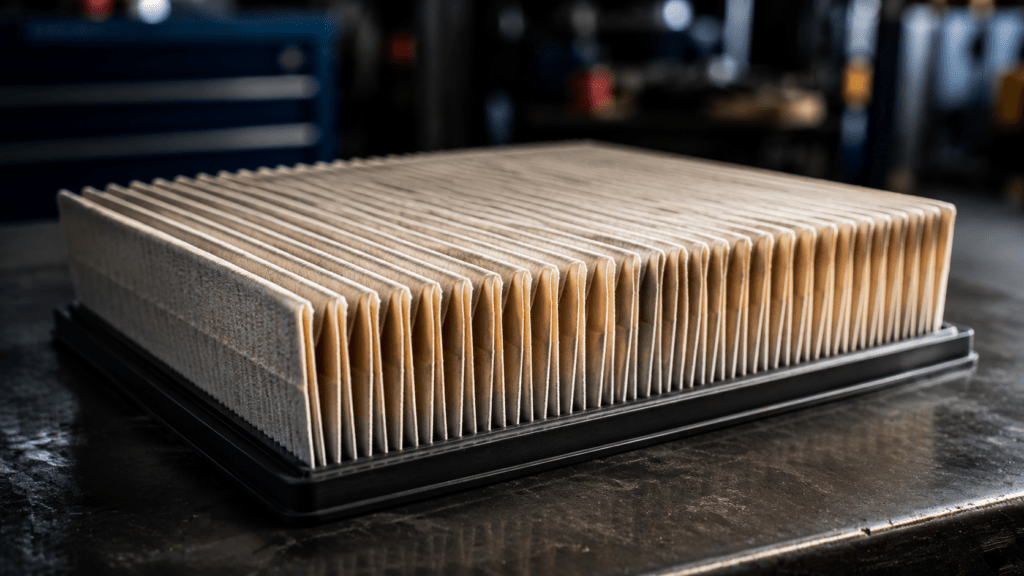
Most vehicle owners track oil change intervals and tire wear closely, but the air filter often gets skipped in that routine — even though choosing the best car air filter has a direct effect on engine performance, fuel use, and long-term reliability.
A car air filter keeps dust, dirt, pollen, and other airborne particles out of the engine. The engine needs a precise air-to-fuel ratio for combustion, and a clogged or low-quality filter throws that balance off, which lowers efficiency and raises maintenance costs over time.
This guide covers how a car air filter works, the main types available, how to pick the right one for your vehicle, replacement intervals, and what changes for cars driven on Indian roads.
What is a car air filter?
A car air filter sits inside the vehicle’s air intake system. Its job is to clean incoming air before it reaches the engine.
The filter media traps particles such as dust, sand, pollen, insects, and road debris, while letting clean air pass through to the combustion chamber. Without that layer of protection, these particles wear down pistons, cylinder walls, and other internal components much faster than they should.
How a car air filter works
Air enters through the filter housing and passes through the filter media. The media catches particles based on their size, then the filtered air moves into the engine and mixes with fuel for combustion.
A well-built filter balances two things at once: high filtration efficiency and low resistance to airflow. A filter that blocks too much airflow chokes engine performance, even if it filters well. One that lets too much through protects the filter media’s reputation but not the engine.
Why a car air filter matters
Better engine performance
The engine needs a steady, unrestricted supply of air to combust fuel efficiently. A clean filter keeps that supply steady, which shows up as smoother acceleration and more consistent throttle response.
Improved fuel efficiency
A clogged filter forces the engine to work harder to pull in the air it needs. Replacing a dirty filter on schedule helps keep fuel consumption closer to what the manufacturer rated the vehicle for, particularly in dusty conditions where filters clog faster.
Cleaner airflow
Quality filtration keeps abrasive particles out of the intake system. That cleaner airflow reduces internal engine contamination and supports more complete combustion.
Longer engine life
Unfiltered dust acts as an abrasive. Over time it damages pistons, cylinder walls, valves, turbochargers, and sensors. A filter that does its job consistently reduces this wear and adds years to an engine’s working life.
Lower maintenance costs
A clean intake system lowers the odds of sensor contamination and air intake faults. A routine filter change costs a fraction of what an engine repair or turbocharger replacement runs to, which makes it one of the cheapest forms of preventive maintenance available.
Types of car air filters
Different filter materials trade off cost, airflow, and service life differently. The table below gives a quick comparison before the detail.
| Filter type | Material | Reusable | Best for |
|---|---|---|---|
| Paper filter | Pleated paper media | No | Daily drivers, standard passenger cars |
| Foam filter | Porous foam | Yes, washable | Off-road vehicles, dusty environments |
| Cotton gauze filter | Oiled cotton layers | Yes, with re-oiling | Performance-focused vehicles |
| Synthetic filter | Synthetic fiber blend | No | Premium vehicles, demanding conditions |
Paper air filters
Paper filters are the standard OEM choice for most vehicle manufacturers. They are affordable, widely available, and easy to replace, with good filtration efficiency for typical road dust and pollen.
The tradeoff is service life. Paper filters are not washable, so they need scheduled replacement rather than cleaning.
Foam air filters
Foam filters use a porous material with strong dirt-holding capacity. They are washable and reusable, which makes them a common choice for off-road vehicles that see heavy dust exposure.
They do need periodic cleaning, and a foam filter that is not maintained on schedule can start to restrict airflow.
Cotton gauze air filters
Cotton gauze filters use several layers of oiled cotton to combine high airflow with reusability. Performance-focused owners often choose these for the airflow gain, accepting a higher upfront cost and the maintenance work of cleaning and re-oiling.
Synthetic air filters
Synthetic filters use engineered fiber media built for high filtration efficiency and a long service life. They cost more than paper filters but hold their performance longer, which suits premium vehicles and harsh operating conditions.
Quick Comparison Chart: Best Car Air Filter by Driving Need
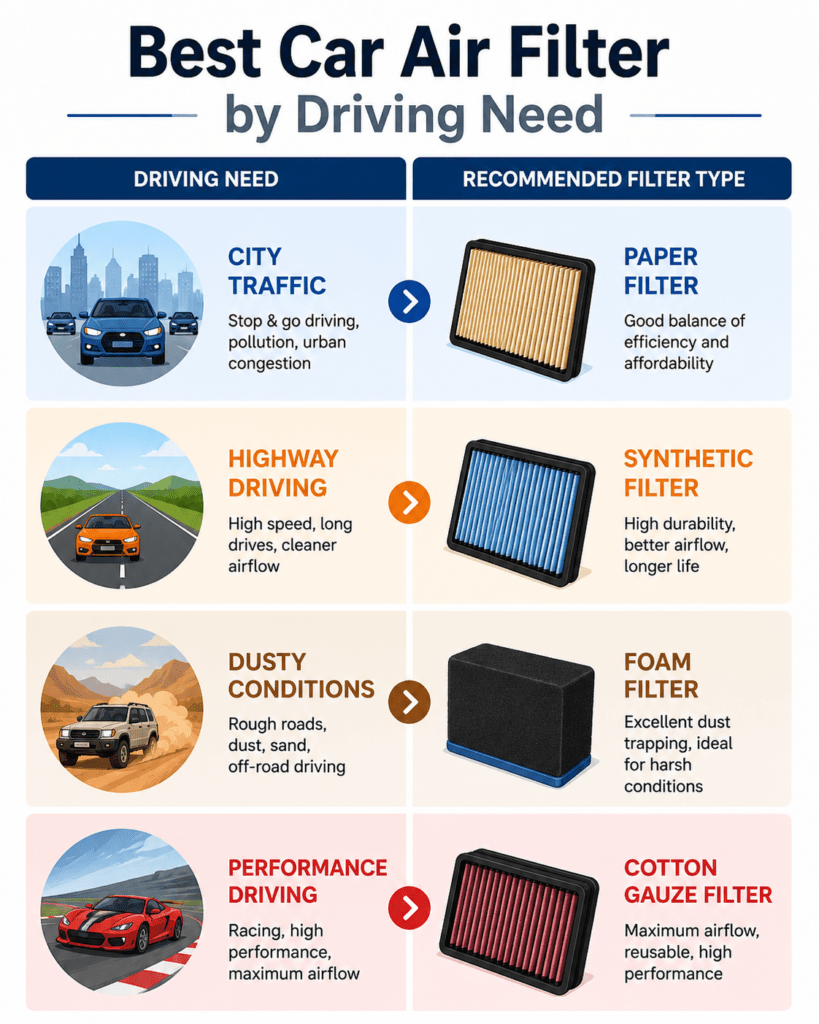
This is the fastest way to match a filter type to how you actually drive:
| Driving Need | Recommended Filter |
|---|---|
| Daily city driving | OEM Paper Filter |
| Highway driving | Synthetic Filter |
| Dusty areas | Foam / Synthetic Filter |
| Performance cars | Cotton Gauze Filter |
If your driving falls across more than one category — say, city commuting most of the week with occasional highway trips — lean toward the option built for the more demanding condition rather than the average one.
How to choose the best car air filter
Picking a filter takes more than choosing the lowest price on the shelf.
Vehicle compatibility. Check the filter against your vehicle’s make, model, engine type, and manufacturing year. A filter that does not seal properly lets contaminants bypass the filtration system entirely.
Filtration efficiency. Look for a manufacturer that publishes filtration performance data rather than vague marketing claims. A filter that captures fine particles while keeping airflow steady is doing its job correctly.
Airflow performance. The best car air filter for your vehicle balances airflow with filtration rather than maximizing one at the expense of the other.
Build quality. Check the filter media, frame strength, and sealing gasket. A weak frame or a poor gasket seal undoes the benefit of good filter media.
Manufacturer reputation. Established automotive filtration manufacturers tend to hold tighter quality control standards, which shows up in consistent fitment and performance across batches.
OEM specifications. When in doubt, choose a filter that meets or exceeds the OEM specification for your vehicle. That spec was set based on the engine’s actual airflow requirements.
Signs your car air filter needs replacement
A dirty filter shows up across more than one part of the vehicle. Watch for:
- Reduced acceleration response
- Lower fuel economy than usual
- Black smoke from the exhaust
- Engine misfiring
- Visible dust or discoloration on the filter itself
- A check engine light tied to airflow sensors
How often should you replace a car air filter?
Most manufacturers recommend inspection or replacement every 12,000 to 15,000 kilometers, or on the schedule listed in the owner’s manual.
That interval shortens for vehicles driven through construction zones, rural roads, mining areas, or desert regions, where dust loads are higher than average. The owner’s manual stays the most reliable reference for your specific vehicle.
Best car air filter for Indian driving conditions
Indian roads put filtration to the test in a few specific ways.
Many regions carry high airborne dust levels for most of the year, so filters with strong dust-holding capacity hold up better than standard units. City driving adds pollution and fine particulate matter on top of stop-and-go traffic, which means efficient filtration matters even on short commutes.
Highway driving needs stable airflow over long, continuous runs, so a filter that holds its performance under extended use matters more than one built for short trips. Monsoon season adds humidity into the mix, so filters with moisture-resistant media hold up better through the wet months than filters without that protection.
OEM vs aftermarket air filters
| Feature | OEM air filters | Aftermarket air filters |
|---|---|---|
| Fitment | Excellent | Varies by brand |
| Quality | Consistent | Depends on manufacturer |
| Cost | Higher | Usually lower |
| Availability | Good | Very good |
| Performance options | Limited | Wider selection |
| Warranty compatibility | Excellent | Check manufacturer guidelines |
OEM filters give predictable fitment and performance. A high-quality aftermarket filter from a reputable manufacturer can match or exceed that performance, but the gap between a good aftermarket filter and a poor one is wide, which is why the manufacturer matters as much as the filter type.
Common mistakes when buying a car air filter
Buying the wrong size. Incorrect fitment lets contaminants bypass the filter entirely. Verify the part number before buying, not after.
Choosing only by price. The cheapest option on the shelf often compromises filtration efficiency or durability. Price matters, but it should not be the only factor in the decision.
Ignoring filtration efficiency. Airflow numbers get attention because they are easy to advertise, but filtration efficiency is what actually protects the engine. Weigh both before buying.
Delaying replacement. Even a well-built filter loses effectiveness once it is overloaded with contaminants. Regular inspection catches this before it affects performance.
Why choose Best Air Filters
[Suggested image — team/warehouse or product range photo. Alt text: “Best Air Filters – trusted supplier of car air filters in India”]
Best Air Filters supplies air filters built for Indian driving conditions, across paper, foam, cotton gauze, and synthetic media.
- [X] years of experience serving Indian vehicle owners, with a track record built on consistent fitment and performance rather than one-off sales
- Wide vehicle segment coverage — including [hatchbacks, sedans, SUVs, and commercial vehicles — update with your actual range], so you’re not stuck searching multiple suppliers for different vehicles in your household or fleet
- OEM-grade testing on fitment and filtration performance before a filter is listed, so what you receive matches the spec your engine was designed around
- Genuine fitment guidance matched to your vehicle’s make, model, and engine type
- Stronger dust-holding capacity built into filters meant for high-dust regions
- Pan-India delivery, with fast dispatch across Delhi NCR so a worn filter does not sit unreplaced for weeks
- WhatsApp support for quick fitment questions, order updates, and replacement reminders — no waiting on hold or digging through email
- Replacement reminders and support for fleet and multi-vehicle owners
Reach out with your vehicle’s details, and the team will point you to the filter built for your actual driving conditions, not a generic best-seller.
Note for the website owner: the bracketed items above (years of experience, vehicle segments, testing process specifics) are placeholders. Swap in your actual numbers and coverage before publishing — claims like “OEM-grade testing” should reflect a real process, since overstated claims here hurt trust more than a shorter, honest list would.
Why this guide follows Google's E-E-A-T standard
Google’s own documentation for content creators, “Creating helpful, reliable, people-first content,” asks whether a page reflects real, first-hand knowledge of a topic or just repeats generic claims with the right keywords attached.
A buying guide for car air filters should come from people who understand filter media, micron-level filtration, and how Indian road conditions affect filter life, not from a template filled in with stock phrases. That is also why this guide names specific filter types, gives a real replacement interval instead of a vague one, and separates OEM from aftermarket performance honestly instead of pushing one option without reason.
For a reader trying to choose between four filter types and two sourcing options, that level of specific, accurate detail is the difference between a page that helps and one that just fills space.
Frequently asked questions
Which is the best car air filter?
The best car air filter is the one that matches your vehicle’s specifications, delivers high filtration efficiency, and comes from a manufacturer with a consistent quality record. For most drivers, OEM-quality paper or synthetic filters cover this well.
Does an air filter improve mileage?
A clean air filter helps maintain proper airflow, which supports fuel efficiency. How much it improves depends on how clogged the old filter was and the conditions the vehicle runs in.
How long does a car air filter last?
Most car air filters last between 12,000 and 15,000 kilometers under normal driving conditions. Vehicles driven in dusty areas need more frequent replacement than that range suggests.
Can I clean and reuse my air filter?
Foam and cotton gauze filters are built to be cleaned and reused according to the manufacturer’s instructions. Standard paper filters should be replaced rather than cleaned, since cleaning damages the paper media.
Conclusion
A car air filter protects the engine and keeps performance consistent, which makes it one of the simplest maintenance items to get right. Clean, properly filtered air supports efficient combustion, smoother operation, and a longer engine life. Whether you drive daily in city traffic, on the highway, or through dusty terrain, choosing the best car air filter for your specific driving conditions makes that protection consistent rather than occasional.
Choosing a filter that meets or exceeds OEM specifications helps maintain fuel efficiency, lowers maintenance costs, and improves overall reliability. Check your filter regularly, especially if you drive on dusty roads or in heavy traffic, since timely replacement remains one of the cheapest ways to protect the engine long term.