
Table of Contents
ToggleAutomotive Filters Manufacturer India | Best Air Filter
Written by Neeraj Goel, Founder, Best Air Filter — 10+ years manufacturing HVAC and industrial air filters in Delhi.
Best Air Filter manufactures automotive filters for engine air, oil, fuel, and cabin systems, built to custom specs for OEM buyers, fleet operators, and vehicle manufacturers across India.
What is an automotive filter
An automotive filter removes contaminants from the air, oil, or fuel entering a vehicle’s engine or cabin. Every car uses at least four separate filter systems, each protecting a different part of the vehicle from dirt, dust, moisture, and debris.
Get it wrong and the cost shows up fast: lower fuel economy, engine wear, clogged injectors, or dirty cabin air. Get it right and the filter does its job for the full service interval without anyone thinking about it.
That second outcome depends on two things: filter design and manufacturing consistency. This page covers both, along with what to check before choosing a supplier.
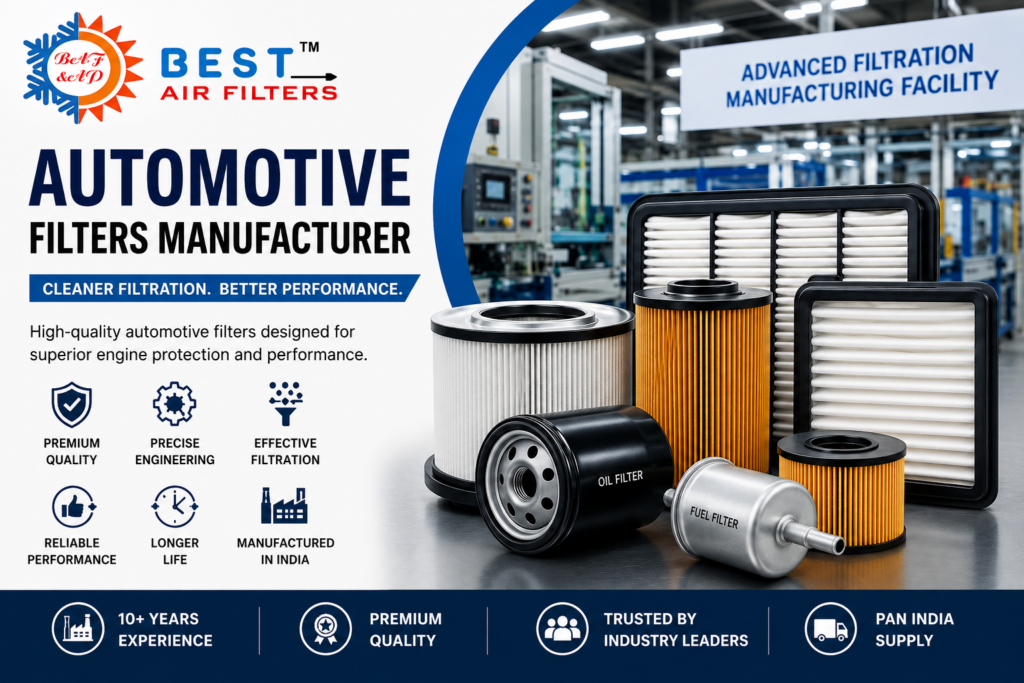
Types of automotive filters we manufacture
Four filter types cover most of what a passenger vehicle or commercial fleet needs.
Engine air filter. Sits between the intake and the combustion chamber. Traps dust, sand, and airborne debris before it reaches the engine. A clogged air filter restricts airflow, which cuts horsepower and fuel efficiency.
Oil filter. Removes metal shavings, carbon deposits, and sludge from circulating engine oil. Runs continuously while the engine is on. A failing oil filter lets contaminants recirculate, which accelerates engine wear.
Cabin air filter. Filters air entering the passenger compartment through the HVAC system. Blocks pollen, road dust, and in HEPA-grade versions, fine particulate matter down to 0.3 microns.
Fuel filter. Positioned between the fuel tank and the engine. Stops rust particles, dirt, and sediment from reaching fuel injectors. A blocked fuel filter causes stalling, hard starts, and reduced power under load.
Some vehicles also use transmission filters and hydraulic filters, particularly in commercial and industrial applications. We manufacture these on request for fleet and OEM clients.
Engine air filter: how it works
Air enters the intake system before the throttle body, and the air filter sits directly in that path. Pleated media increases the surface area available for filtration inside a compact housing, which lets the filter trap more debris before airflow resistance rises to a point that affects engine performance.
A new engine air filter typically allows more airflow than a worn one, which is why fuel efficiency and throttle response often improve right after replacement. Engines running in dusty conditions, such as construction sites or rural roads, load up the filter faster and need more frequent inspection.
Oil filter: how it works
Oil filters use a spin-on or cartridge design, depending on the engine. Oil passes through pleated media that traps metal shavings, carbon buildup, and sludge before the oil returns to circulation.
Most oil filters include a bypass valve. If the filter becomes too clogged to let oil through at the required rate, the bypass valve opens and lets unfiltered oil continue circulating rather than starving the engine of lubrication. This protects the engine short-term but means a badly clogged filter is no longer doing its job.
Cabin air filter: how it works
Air entering the HVAC system passes through the cabin filter before reaching the vents. Standard cabin filters block dust, pollen, and larger particles. HEPA-grade cabin filters add a denser media layer that captures particles down to 0.3 microns, including fine particulate matter and some airborne allergens.
Cabin filters sit in a less demanding environment than engine filters, since they don’t face combustion byproducts or extreme heat. That said, they clog with dust and debris over time just like any other filter, and a blocked cabin filter reduces HVAC airflow even when the system otherwise works fine.
Fuel filter: how it works
Fuel filters sit inline between the tank and the engine, and in some vehicles a second filter sits inside the fuel pump assembly. The filter removes rust particles, dirt, and water contamination before fuel reaches the injectors, which run at tight tolerances and clog easily if contaminated fuel gets through.
Diesel engines generally need more robust fuel filtration than petrol engines, since diesel fuel systems run at higher pressure and are more sensitive to water contamination.
| Filter type | Primary contaminant | Typical micron rating | Location |
|---|---|---|---|
| Engine air filter | Dust, sand, debris | 5 to 20 microns | Intake system |
| Oil filter | Metal particles, carbon | 15 to 40 microns | Engine oil circuit |
| Cabin air filter | Pollen, dust, PM2.5 | 0.3 to 10 microns (HEPA) | HVAC intake |
| Fuel filter | Rust, sediment, water | 5 to 20 microns | Fuel line |
According to NAPA Auto Parts and Valvoline’s filter guide, these four systems cover nearly every filtration point in a standard passenger vehicle.
Filter media: what the filter is actually made of
The material inside a filter determines how well it works, how long it lasts, and how much it costs.
Paper media. The most common choice for engine air filters and oil filters. High filtration efficiency, low cost, but limited dust-holding capacity before it needs replacement.
Foam media. Handles dusty, off-road, or high-vibration conditions better than paper. Can be oiled and reused, which makes it common in performance and off-road applications.
Cotton gauze media. Layered cotton treated with oil. Lower initial restriction, reusable, but requires regular cleaning and re-oiling to maintain efficiency.
Synthetic media. Lasts longer than paper, tolerates higher temperatures, and holds more contaminants before clogging. Costs more upfront but often works out cheaper over the life of a fleet vehicle due to longer service intervals.
| Media type | Efficiency | Reusable | Best for |
|---|---|---|---|
| Paper | High | No | Standard passenger vehicles |
| Foam | Medium-high | Yes | Dusty or off-road conditions |
| Cotton gauze | Medium | Yes | Performance applications |
| Synthetic | High | No | Fleet vehicles, harsh environments |
Two filters can look identical from the outside and perform completely differently based on pleat count, seal quality, and media density. A poorly sealed filter lets unfiltered air or fluid bypass the media entirely, which defeats the point of installing it in the first place.
Understanding filtration ratings
Filter specs get communicated through a few standard measurements, and knowing what they mean makes it easier to compare suppliers.
Micron rating. Describes the smallest particle size a filter reliably captures. A lower micron rating means finer filtration. Engine air filters typically fall between 5 and 20 microns, while HEPA-grade cabin filters capture particles as small as 0.3 microns.
Efficiency percentage. Shows what share of particles at the rated micron size the filter actually captures. A filter rated at 99% efficiency at 10 microns catches 99 out of every 100 particles that size or larger.
Dust-holding capacity. Measures how much contaminant a filter can hold before airflow resistance rises past a usable threshold. Higher dust-holding capacity means longer service life between replacements, particularly relevant for fleet vehicles operating in dusty environments.
MERV rating. Common in HVAC filtration and increasingly referenced in cabin air filter specs. Ranges from 1 to 20, with higher numbers indicating finer filtration.
ISO 16889. The international standard used for testing hydraulic and lubrication filters, relevant for transmission and hydraulic filter specs in commercial vehicles.
Our team documents these specs for every custom automotive filter order, so buyers can compare against OEM requirements or a previous supplier’s spec sheet before committing to a batch.
Custom automotive filters vs standard sizes
Standard filter sizes work fine for common passenger vehicles. They don’t work well for:
- Commercial fleets with non-standard housings
- OEM production lines that need filters built to exact engineering drawings
- Specialized equipment where a generic filter reduces performance
- Operations in harsh conditions that need higher dust-holding capacity than a stock filter provides
Custom manufacturing solves this by building the filter to match the vehicle or equipment spec, rather than forcing the vehicle to fit a standard part. This is common practice in industrial filtration and increasingly requested by fleet buyers who want a manufacturing partner instead of a parts vendor.
At Best Air Filter, custom automotive filters go through the same design process used for our industrial and pharmaceutical filtration work: confirm the dimensions and housing specs, select the media based on operating conditions, build a sample, test it, then move to production.
How we manufacture automotive filters
Filtration has been the core business at Best Air Filter since 2017. The company started in industrial and HVAC filtration and expanded into automotive filters using the same process controls applied to pharmaceutical cleanroom filtration.
That connection matters more than it sounds. A HEPA filter built for a pharmaceutical cleanroom and an automotive cabin filter solve the same underlying problem: stop particles at a specific size, consistently, batch after batch. The tolerances in cleanroom work are tighter than the minimum required for automotive parts, and applying that discipline to automotive filters raises the baseline for the whole product line.
Our manufacturing process for automotive filters includes:
- Spec confirmation. Dimensions, housing type, and operating environment get confirmed before production starts.
- Media selection. Paper, foam, cotton, or synthetic, chosen based on the vehicle’s use case and the buyer’s priorities on cost, efficiency, and lifespan.
- Sample production. A prototype gets built and tested against the target spec before full-batch manufacturing begins.
- Batch testing. Airflow resistance, dust-holding capacity, and seal integrity get checked, not just on the first unit but across the production run.
- Delivery. PAN India supply, with direct technical support for fleet and OEM buyers.
Industries we serve
Best Air Filter works across pharmaceuticals, hospitals, HVAC, electronics, food processing, and automotive manufacturing. Clients include Amity University and Dynamic Transmission Ltd, along with fleet and industrial buyers across India.
Serving multiple industries under one roof means the same testing standards apply everywhere. A filter built for a pharmaceutical cleanroom, a hospital HVAC system, and a commercial vehicle fleet all go through the same batch verification process before they leave the facility. Few automotive-only suppliers can say the same, since most source filters rather than manufacture them.
OEM vs aftermarket automotive filters
Buyers usually choose between two paths: source from the vehicle manufacturer’s approved OEM supplier, or buy aftermarket filters built to match the same fitment and performance spec.
| Factor | OEM | Aftermarket |
|---|---|---|
| Fitment | Exact match | Usually exact, verify before ordering |
| Cost | Higher | Lower to comparable |
| Availability | Often limited to dealer network | Wider supply options |
| Customization | Rarely available | Available from manufacturers offering made-to-order production |
| Lead time | Can be long for bulk orders | Faster for manufacturers with in-house production |
For fleet operators and OEM production buyers, the real question isn’t OEM vs aftermarket. It’s whether the aftermarket supplier can match OEM tolerances consistently across a large order. That comes down to whether they manufacture the filter themselves or import and relabel it.
How often to replace automotive filters
Replacement intervals depend on the filter type and driving conditions.
| Filter type | Typical replacement interval |
|---|---|
| Engine air filter | 15,000 to 30,000 km |
| Oil filter | With every oil change |
| Cabin air filter | 15,000 to 20,000 km, or annually |
| Fuel filter | 30,000 to 40,000 km |
Dusty roads, stop-and-go traffic, and short trips all shorten these intervals. Fleet operators should track replacement by usage hours or kilometers rather than calendar time, especially for vehicles running in industrial or high-dust environments. AutoZone’s filter guides note similar variation based on driving conditions, and our team can help set a maintenance schedule matched to your specific fleet.
Signs a filter needs replacing
- Reduced fuel efficiency or a noticeable drop in power
- Rough idle or hesitation on acceleration
- Musty or stale smell from the AC vents
- Visible dirt, discoloration, or clogging during inspection
- Engine warning light related to airflow or fuel delivery
Common mistakes buyers make
Choosing on price alone. A cheaper filter that fails early costs more in engine wear and downtime than the savings on the initial purchase. This matters most for fleet buyers running dozens or hundreds of vehicles, where one bad batch creates a maintenance backlog.
Assuming all filters with the same part number perform the same. Two filters can share a listed part number and still differ in media density, seal quality, and dust-holding capacity. Sourcing from a manufacturer that documents test data avoids this problem.
Skipping cabin filter replacement. Engine filters get attention because engine performance is easy to notice. Cabin filters often go years without replacement since the symptoms, reduced airflow and odor, are easy to miss or attribute to something else.
Ignoring operating environment when specifying filters. A filter spec that works for city driving may underperform in a dusty industrial site or a coastal humid climate. Sharing the operating environment with the manufacturer during spec confirmation avoids premature filter failure.
Ordering standard sizes for non-standard equipment. Fleet vehicles and industrial equipment often use housings that don’t match passenger car dimensions. Forcing a standard filter into a non-standard housing creates seal gaps that let unfiltered air or fluid bypass the media.
Sustainability and filter life
Longer-lasting filters mean fewer replacements, less packaging waste, and lower total cost over a vehicle’s service life. Synthetic media filters generally last longer than paper equivalents, which reduces the frequency of replacement without compromising filtration efficiency.
For fleet operators managing dozens of vehicles, extending filter life by even a few thousand kilometers per unit adds up to a meaningful reduction in waste and procurement overhead across a full year of operation. This is one of the reasons custom-spec synthetic filters have become more common in commercial fleet contracts over the past several years.
Quality testing and standards
A serious filter manufacturer runs tests beyond a visual check. Our process includes airflow resistance testing, dust-holding capacity checks, and seal integrity verification on every production batch, not just the initial sample.
Filters that pass consistent testing hold their rated efficiency for the full service interval, instead of losing performance a few thousand kilometers in. This matters most for fleet and OEM buyers, where inconsistent filter quality across a large batch creates maintenance problems that are hard to trace back to the source.
Why choose a manufacturer over a retailer
Anyone can import filters and put a label on the box. Fewer companies actually manufacture filters to a documented, testable spec.
Before choosing an automotive filter supplier, it’s worth checking:
- Do they test every batch, or just the first unit? Filtration efficiency should be verified on an ongoing basis, not assumed from a design spec.
- Can they customize dimensions and media? Standard sizes don’t cover every fleet vehicle or piece of equipment.
- What other industries do they serve? A manufacturer supplying pharmaceutical or hospital-grade filtration usually works to tighter tolerances than one focused only on retail auto parts.
- How fast can they deliver at volume? Fleet operators and OEM buyers need consistent, repeatable supply.
- Do they offer direct technical support? Filter selection for non-standard applications benefits from someone who understands the engineering, not just the catalog.
Bulk and OEM supply
Best Air Filter supplies automotive filters in bulk for fleet operators, OEM production lines, and industrial buyers across India. Orders get built to your spec, tested in batch, and shipped PAN India with direct technical support throughout.
If you need a custom filter spec, a downloadable catalog, or a quote for volume supply, our team responds directly, including over WhatsApp for faster turnaround on fleet and OEM inquiries.
Frequently asked questions
What is an automotive filter?
An automotive filter removes dust, particles, and contaminants from the air, oil, or fuel systems in a vehicle. Common types include engine air filters, oil filters, cabin air filters, and fuel filters.
How many filters does a car have?
Most passenger vehicles have four main filters: an engine air filter, an oil filter, a cabin air filter, and a fuel filter. Some vehicles add a transmission filter or hydraulic filter depending on the drivetrain.
How often should automotive filters be replaced?
Engine air filters typically last 15,000 to 30,000 km, oil filters get replaced with every oil change, cabin filters last 15,000 to 20,000 km or one year, and fuel filters last 30,000 to 40,000 km. Driving conditions can shorten these intervals.
What’s the difference between OEM and aftermarket automotive filters?
OEM filters come from the vehicle manufacturer’s approved supplier and match exact factory specs. Aftermarket filters are built by third-party manufacturers to the same fitment and performance standards, often at a lower cost and with more customization available.
Are custom automotive filters worth it for a small fleet?
Yes, if the fleet uses non-standard vehicles or equipment, or operates in harsh conditions like dusty industrial sites. Custom filters fit better and often last longer than generic replacements pulled off a shelf.
Does Best Air Filter manufacture filters for specific vehicle models?
Yes. Filters get custom made to match specific dimensions, media requirements, and efficiency ratings for both passenger vehicles and commercial fleets.
What filter media should I choose for a dusty environment?
Foam or synthetic media generally outperforms paper in high-dust conditions, due to higher dust-holding capacity before the filter clogs. Our team can recommend a spec based on your specific operating environment.
Get in touch
For custom automotive filter specs, bulk quotes, or technical support, contact our team directly.
Email: bafcustomercare@gmail.com Phone: 9999790843 Address: 197/3, Gali No. 3, Padam Nagar, Sarai Rohilla, Delhi, 110007, India
More filtration guides and technical breakdowns are available on the Best Air Filter blog.