
Table of Contents
ToggleCabin air filter: complete guide, types, replacement, and how to choose the right filter for your car
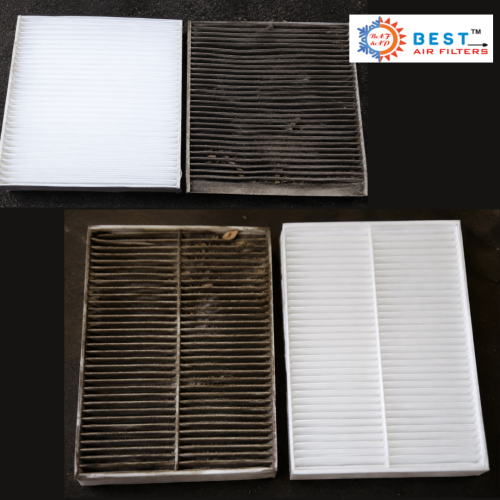
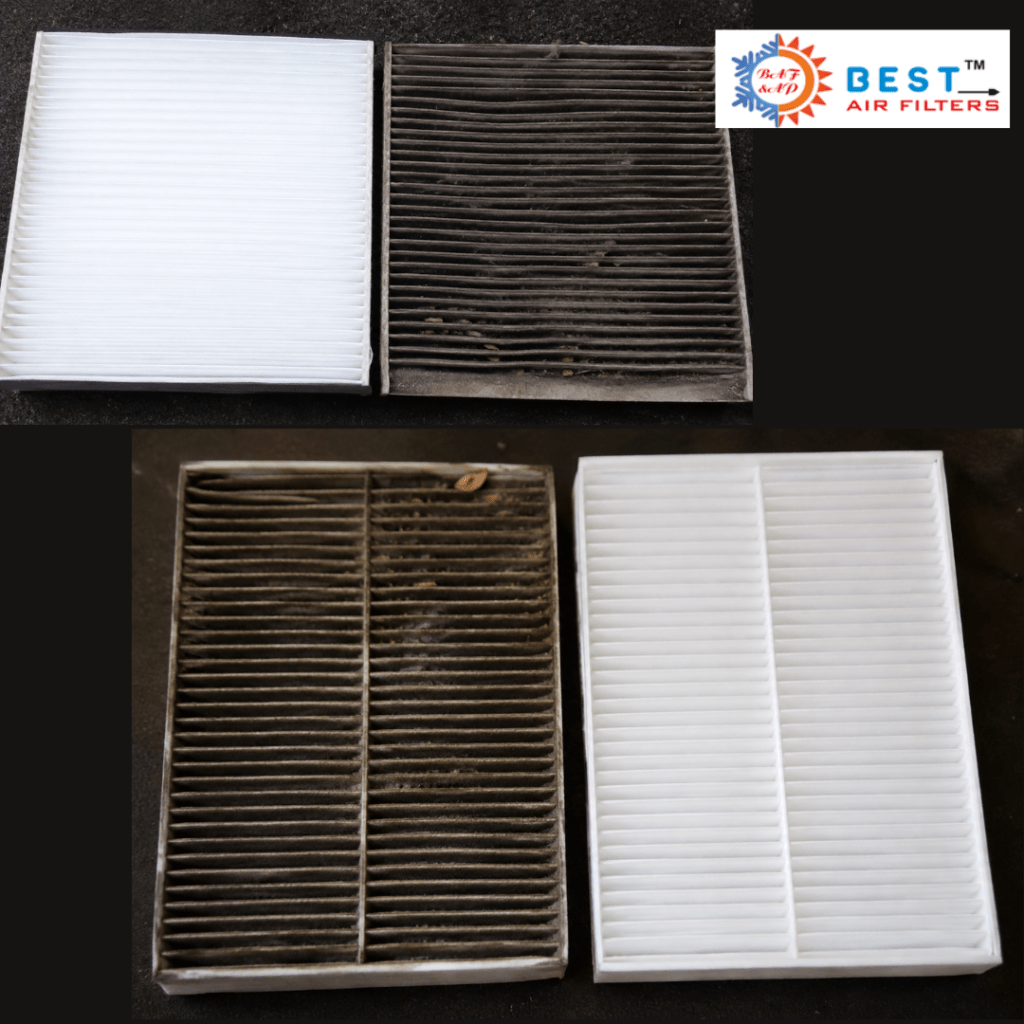
pulled from a vehicle after 8,000 to 10,000 km, showing visible dust and discolouration on the used filter.
A cabin air filter is a small pleated filter fitted inside your car’s HVAC system. It cleans the air entering your car’s interior before it reaches you and your passengers. In Indian driving conditions, most vehicles need this filter replaced every 8,000 to 10,000 km, or every 6 to 8 months, whichever comes first, given the higher dust and pollution load on Indian roads compared to global averages.
The rest of this guide covers what the filter does, which type fits your driving conditions, how to find the exact filter for your car, and how to replace it yourself. This guide is brought to you by BestAirFilter.in, where we manufacture and test cabin air filters for Indian driving conditions.
What is a cabin air filter?
A cabin air filter is roughly the size of a hardcover book. It sits inside your car’s HVAC housing, usually behind the glovebox, and is built from pleated synthetic fiber, sometimes layered with activated carbon or an antimicrobial coating depending on the grade.
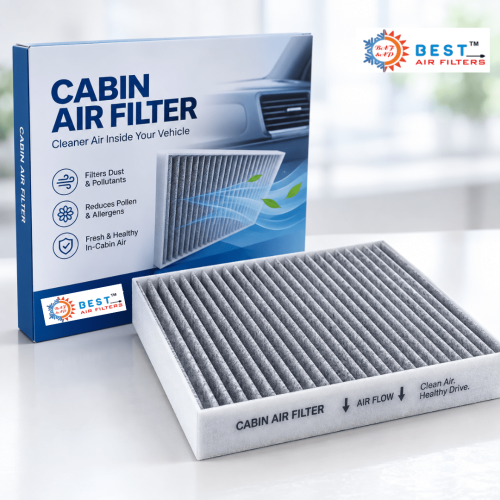
Most cars sold in India today come fitted with one as standard equipment, including budget hatchbacks. Older vehicles, particularly those manufactured before the mid 2000s, sometimes don’t have one at all. If you’re unsure whether your car has a cabin filter, checking your owner’s manual or your vehicle’s parts catalogue will confirm it.
What does a cabin air filter do?
Every time your car’s HVAC system pulls in air, whether you’re running the AC on a Delhi summer afternoon or the heater during a Kashmir winter, that air passes through the cabin filter first. The filter’s job is to trap dust, pollen, brake dust, road particulate, and vehicle exhaust before it reaches the cabin.
This matters more in India than in most parts of the world. Several Indian cities regularly report PM2.5 levels several times higher than the World Health Organisation’s safe limit, particularly during winter months in North India. A car’s cabin, without proper filtration, offers very little protection from this. A working cabin air filter is one of the few practical barriers between you and that outside air quality during your daily commute.
Beyond air quality, a working filter keeps your HVAC system running efficiently. A clogged filter restricts airflow, forces the blower motor to work harder, and can slow down window defogging, which matters during Delhi’s foggy winter mornings or monsoon downpours when visibility is already compromised.
Cabin air filter vs. engine air filter
These two parts get confused often, mostly because both are called air filters and both sit somewhere inside the car.
They do different jobs entirely.
| Cabin air filter | Engine air filter | |
|---|---|---|
| Location | Behind glovebox or under dashboard | Inside the engine bay |
| Job | Cleans air entering the passenger cabin | Cleans air entering the engine for combustion |
| Affects | Air quality, allergy symptoms, HVAC performance | Engine performance, fuel efficiency, acceleration |
| Signs it’s dirty | Musty smell, weak vents, foggy windows | Rough idling, poor acceleration, lower mileage |
| Typical price in India | ₹300 to ₹1,500 | ₹250 to ₹1,200 |
If your vents smell musty or airflow feels weak, that’s the cabin filter. If your car feels sluggish or fuel efficiency has dropped, check the engine air filter instead.
Types of cabin air filters
Cabin filters come in different grades, each built for a specific level of protection. Choosing the right one depends on where and how you drive.
1. Standard particulate filters
This is the base tier. Standard filters use pleated non-woven fabric to physically trap larger particles: dust, pollen, and road grit. They handle particulate matter well but don’t do much against gases or odours.
This tier suits drivers in smaller cities or towns with lower traffic density and less industrial pollution, where dust is the main concern rather than exhaust gases. Browse our standard particulate cabin air filters to check compatibility with your vehicle.
2. Activated carbon filters
These add a layer of activated carbon on top of standard particulate filtration. Activated carbon works by adsorption: gas molecules bind to the carbon’s surface as air passes through. This layer reduces exhaust odour, diesel smell, and gases like ozone that a standard filter lets through untouched.
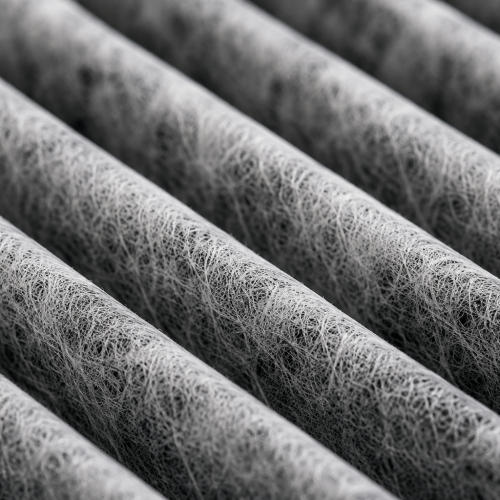
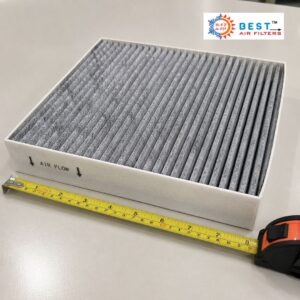
showing the pleat structure and carbon layer if applicable. This is one of the strongest trust signals you can add, since generic stock photos can’t show your specific product’s construction.
For anyone commuting through Indian metros with heavy traffic congestion, this is usually the better baseline choice over a standard filter, given how much time is spent idling near other vehicles’ exhaust. See our activated carbon cabin air filter range for metro-driving conditions.
3. PM2.5 and HEPA-grade filters
The top tier combines particulate capture, activated carbon, and often an additional fine-particle layer built to trap particles down to PM2.5 size, the category small enough to penetrate deep into the lungs and the same size class Indian air quality indices track closely during pollution season.
For drivers in Delhi NCR, Kanpur, Lucknow, or other cities that regularly see hazardous AQI readings, a PM2.5-rated filter offers meaningfully better protection than a standard or carbon filter alone, particularly between October and February when pollution levels peak across North India. Check our PM2.5 and HEPA-grade cabin air filters for the highest protection tier we offer.
Standard vs. carbon vs. PM2.5 vs. HEPA: quick comparison
| Filter type | Blocks dust and pollen | Blocks odour and gases | Blocks fine particulates (PM2.5) | Best suited for |
|---|---|---|---|---|
| Standard particulate | Yes | No | No | Smaller cities, lower traffic density |
| Activated carbon | Yes | Yes | Partial | Metro commuters, heavy traffic |
| PM2.5/HEPA-grade | Yes | Yes | Yes | North Indian cities during pollution season, allergy sufferers |
If you’re not sure which tier fits your situation, a simple rule works well: match the filter to your worst driving condition, not your average one. If you drive mostly on open roads but occasionally sit in Delhi traffic during a work trip, the occasional exposure is still worth planning for.
A note on filtration claims. Exact filtration percentages vary by product, media type, and testing method, so this guide avoids stating specific efficiency numbers that aren’t tied to a verified test result. Where we quote a filtration rating for our own filters, it’s based on internal or third-party lab testing for that specific product, and we publish the test method alongside the number on the product page. If a filter’s listing anywhere makes a filtration claim with no stated test method or standard behind it, treat that number with caution.
Signs your cabin air filter needs replacement
A cabin filter clogs gradually, which is why the symptoms often go unnoticed until they’re fairly advanced. Watch for these signs:
Musty smell when the AC or heater turns on. Usually the first sign drivers notice, particularly after the car has been parked for a while.
Weak airflow from the vents, even with the fan on the highest setting.
Windows fogging up more slowly than usual to clear, which matters especially during monsoon season or foggy winter mornings.
A faint whistling sound from the vents at higher fan speeds, caused by air being forced through a narrower path than the filter allows.
More sneezing or watery eyes specifically while driving, but not elsewhere, pointing to degraded cabin air quality.
Visible dust settling faster on the dashboard than it used to.
If two or more of these show up, it’s a strong signal the filter needs changing, even if you haven’t hit your mileage interval yet.
How often to replace in Indian driving conditions
Global manufacturer guidelines often say 12,000 to 15,000 km. In Indian conditions, this interval usually needs to shorten, and here’s why: higher ambient dust levels, denser traffic, more idling time, and in several regions, significantly worse air quality than the global average this guideline was built around.
City driving in high-pollution metros (Delhi NCR, Kanpur, Lucknow, Patna): replace every 6 months or 8,000 km, whichever comes first, particularly if you commute regularly between October and February when pollution peaks.
City driving in moderate-pollution metros (Mumbai, Bengaluru, Chennai, Hyderabad): every 8,000 to 10,000 km or 8 months.
Highway-heavy or lower-traffic driving: the standard 10,000 to 12,000 km interval usually holds up fine.
Rural or unpaved road driving: every 5,000 to 6,000 km, since unpaved roads generate substantially more airborne dust than city streets.
Monsoon season: worth an early check regardless of mileage, since trapped moisture in a clogged filter creates ideal conditions for mould growth.
Your vehicle’s service manual will list the manufacturer’s exact recommendation, and that should take priority over general guidance, but the intervals above give a realistic adjustment for Indian conditions specifically.
How to choose the correct filter for your car
Getting the right filter comes down to three things: correct fitment, the right protection tier for your driving conditions, and a filter quality you can trust.
Fitment comes first, always. Cabin filters are vehicle-specific, and in many cases, even variant-specific within the same model year. A filter that fits a base variant may not fit a higher trim with a different HVAC housing. Always confirm using your car’s exact make, model, year, and variant before buying, not just the model name alone.
Match the tier to your driving reality, not to the most expensive option available. A PM2.5-grade filter is the strongest choice for polluted metros, but if you drive mostly in a smaller town with lower pollution, a standard or carbon filter may serve you just as well at a lower cost.
Check the media quality, not just the marketing. A genuine filter uses evenly pleated fibre with consistent density across the panel. Poor-quality aftermarket filters sometimes use thinner, unevenly pleated material that looks similar in photos but performs noticeably worse in actual filtration.
bench, showing the filter media being produced, inspected, or tested. This is a direct experience and expertise signal that no reseller or aggregator content can replicate.
Which cabin filter fits my car? Find it by Make → Model → Year → Variant
Fitment mistakes are the single most common problem in cabin filter buying, since the same model name often ships with two or three different HVAC housings across trims and years. Here’s the exact path to get it right.
Step 1: Make. Start with your vehicle’s brand, for example Maruti Suzuki, Hyundai, Tata, or Mahindra.
Step 2: Model. Narrow to the specific model, for example Swift, Creta, or Nexon.
Step 3: Year. Manufacturing year matters because HVAC housings sometimes change mid-generation, even without a full model redesign.
Step 4: Variant. This is the step most buyers skip, and it’s the one that causes the most returns. A base LXi variant and a top-end ZXi variant of the same model and year can use different filter housings if the higher trim adds climate control features the base trim doesn’t have.
Once all four details are confirmed, there’s typically only one correct filter part number for that exact combination, sometimes two if the manufacturer offers both a standard and a carbon version for the same fitment.
The full fitment path: Make → Model → Year → Variant → Part Number → Dimensions
Here’s what each step in the fitment chain actually confirms, and why skipping any one of them causes a wrong-fit order.
| Step | What it confirms | Why it matters |
|---|---|---|
| Make | Brand-level HVAC design | Different manufacturers use different housing shapes and mounting systems |
| Model | Base HVAC platform for that model | Same brand, different models rarely share a filter housing |
| Year | Generation or facelift changes | A mid-cycle facelift can change the HVAC housing even under the same model name |
| Variant | Trim-specific HVAC features | Higher trims with climate control or dual-zone AC sometimes use a different housing than the base trim |
| Filter part number | The exact SKU that fits | This is the number that guarantees fitment, everything above it narrows down to this |
| Dimensions | Length × width × height, in mm | Useful as a final cross-check, especially if you’re comparing a listed part number against a filter you’re removing from the car |
How to replace a cabin air filter yourself
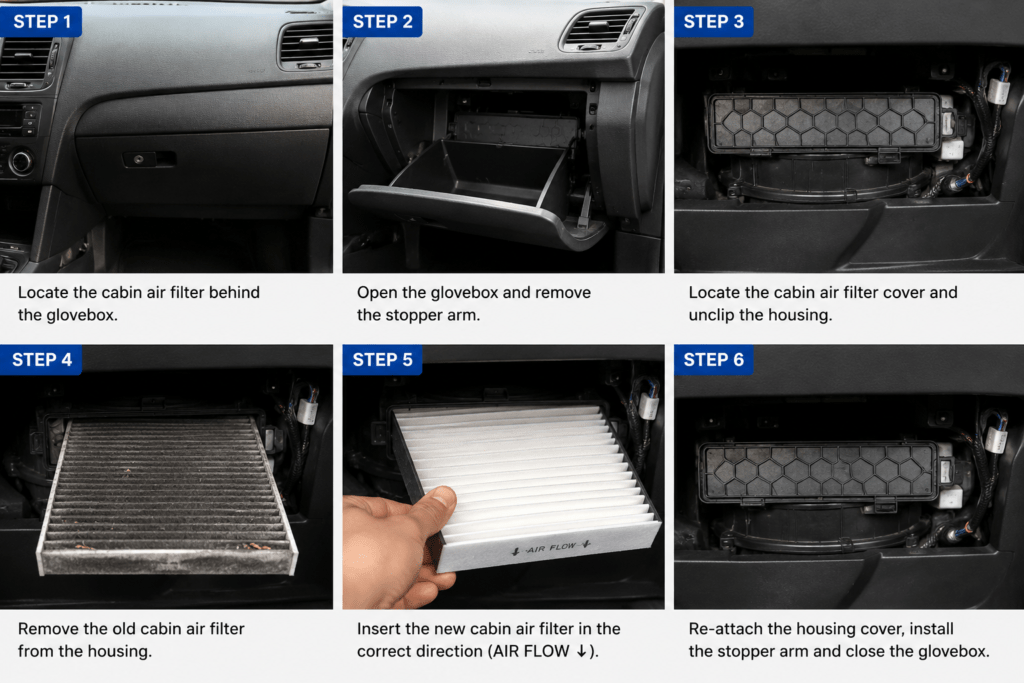
Step 1: Locate the filter. In most vehicles, it’s behind the glovebox. Some cars place it under the dashboard on the passenger side or, less commonly, under the bonnet near the windshield base. Check your owner’s manual if you’re unsure.
Step 2: Empty and lower the glovebox. Remove everything stored inside, then release the side clips or fasteners holding it in place. Most gloveboxes drop down or swing open once these are released, exposing the filter housing.
Step 3: Note the airflow direction before removing the old filter. Look for an arrow printed on the filter’s frame showing the direction air flows through it. The new filter needs to face the same way. A quick photo on your phone before removal saves any guesswork.
Step 4: Slide out the old filter. Pull it straight out of the housing slot. It’s normal for it to look visibly grey or have visible dust caught in the pleats, since that’s exactly why it needs replacing.
Step 5: Insert the new filter. Match the airflow arrow to the same direction as the old filter, and slide it fully into the housing until it seats properly.
Step 6: Reattach the glovebox. Snap the retaining clips back into place and put your glovebox contents back.
Common replacement mistakes
Installing it backwards. The most frequent mistake. The filter will still physically fit if reversed, but filtration efficiency drops and airflow resistance can increase.
Buying by model name alone. Fitment can differ by variant even within the same model year. Always confirm using your exact variant, not just the broad model name.
Forcing a filter that doesn’t seat properly. If it feels tight or needs noticeable force, double check the part number rather than pushing it in, since forcing it can crack the plastic housing.
Ignoring the housing itself. While the glovebox is open, check the filter housing for leaves, dust buildup, or debris. Clearing this out extends the life of the new filter.
OEM vs. aftermarket cabin air filters
This is a common question, and the honest answer depends on what you’re optimising for.
OEM filters, sourced through your car’s dealership network, guarantee exact fitment and are built to the vehicle manufacturer’s original specification, often tested against standards set by bodies like the Automotive Research Association of India (ARAI). They typically cost more than a comparable aftermarket option, and availability can be slower in smaller towns.
Quality aftermarket filters from established filtration manufacturers can match or, in some filtration tiers, exceed OEM specifications, particularly for carbon and PM2.5-grade filters where aftermarket brands often compete directly on filtration performance rather than just fitment. The price is usually lower, and availability through auto parts retailers and online platforms tends to be faster.
The risk with aftermarket isn’t the category itself, it’s inconsistent quality among lesser-known sellers. A filter from an established, quality-focused manufacturer with published filtration specifications is a reasonable choice. A filter from an unverified seller with no stated media type or filtration rating is a gamble, regardless of price.
If budget allows, choosing a reputed aftermarket brand with a carbon or PM2.5 tier generally gives better real-world protection per rupee spent than a basic OEM standard filter, particularly for city driving in polluted regions. You can read more about how we test and manufacture our filters on our quality and testing page.
Cabin air filter price in India
Prices vary by vehicle segment, filter tier, and brand. Here’s a realistic range across common categories.
| Vehicle segment | Standard filter | Carbon filter | PM2.5/HEPA-grade filter |
|---|---|---|---|
| Hatchback (e.g., Swift, i10, WagonR) | ₹250 to ₹450 | ₹400 to ₹700 | ₹600 to ₹1,000 |
| Sedan (e.g., City, Verna, Ciaz) | ₹300 to ₹550 | ₹450 to ₹800 | ₹700 to ₹1,200 |
| SUV/MPV (e.g., Creta, XUV700, Innova) | ₹400 to ₹700 | ₹550 to ₹1,000 | ₹800 to ₹1,500 |
| Premium/luxury vehicles | ₹800 to ₹1,500 | ₹1,200 to ₹2,000 | ₹1,500 to ₹3,000+ |
Professional installation, if you’d rather not do it yourself, typically adds ₹100 to ₹300 at an independent garage, or ₹200 to ₹500 at an authorised dealership, though the job itself remains simple enough that most owners manage it without help after the first attempt.
What happens if you don't replace it
Skipping cabin filter replacement doesn’t cause sudden failure, which is exactly why it’s easy to overlook. The effects build up gradually.
Cabin air quality degrades progressively, exposing occupants to more dust, pollen, and particulate matter over time, a meaningful concern in cities where outdoor AQI already runs high for months at a stretch. The blower motor works harder to push air through an increasingly blocked filter, which can shorten its lifespan and slightly increase electrical load on the system. Persistent musty odours become more common as trapped moisture and debris create favourable conditions for mould growth inside the housing. During monsoon months specifically, a neglected filter combined with humidity is one of the more common causes of that lingering damp smell owners struggle to identify.
None of this happens overnight, but combined over a year or two of neglect, it adds up to noticeably worse air quality and HVAC performance.
When the filter isn’t the actual problem
Sometimes a filter replacement doesn’t fix the symptom it was expected to fix. It’s worth knowing when something else is the actual cause.
Musty smell persists after replacement. This usually points to mould or bacteria growth on the evaporator core rather than the filter itself, and typically needs a dedicated AC system cleaning or sanitising treatment rather than another filter change.
Airflow stays weak despite a new filter. This can mean the blower motor is failing, often accompanied by a grinding or clicking noise, or there’s a separate blockage elsewhere in the ductwork.
AC blows warm air even with a fresh filter. A clogged filter weakens airflow, but it won’t cause warm air on its own. Warm air points toward a refrigerant, compressor, or electrical fault unrelated to the cabin filter.
Checking the filter first still makes sense, since it’s the cheapest and fastest thing to rule in or out before moving to more involved diagnostics.
How your car’s HVAC system uses this filter
Your car pulls air in from one of two sources: outside air through an intake near the windshield base, or recirculated cabin air. Both routes pass through the cabin filter before reaching the blower motor and vents.
In outside air mode, the default in most vehicles, the filter works constantly against whatever the intake pulls in, whether that’s a construction zone on the outskirts of Bengaluru or a diesel bus in Mumbai traffic. Recirculation mode reduces new outside air intake, commonly used to cool the cabin faster or limit exposure during a bad stretch of traffic pollution, but recirculated air still passes through the filter on its way to the vents.
The blower motor sits just past the filter housing. A clean filter lets it run efficiently. A clogged one forces it to work against added resistance, which is the underlying cause behind weaker airflow, unusual noise, and a small increase in electrical load.
Cost breakdown: DIY vs. workshop installation
Since cost is a practical concern for most car owners, here’s a fuller breakdown across common paths in India.
Buying and fitting the filter yourself: Standard filters run ₹250 to ₹700 depending on vehicle segment. Carbon filters run ₹400 to ₹1,000. PM2.5-grade filters run ₹600 to ₹1,500, occasionally higher for premium SUVs and luxury vehicles with larger HVAC housings. Installation costs nothing extra since it’s a straightforward DIY job taking under 15 minutes.
Getting it replaced at an independent garage: The filter cost stays the same, with labour typically adding ₹100 to ₹300 depending on the city and garage.
Getting it replaced at an authorised dealership: Filter pricing is usually closer to OEM rates, and labour tends to run ₹200 to ₹500, sometimes bundled into a routine periodic service package rather than charged separately.
Bundled with a periodic service or oil change: Many garages and dealerships include cabin filter inspection as part of a standard service checklist, and replacing it during the same visit avoids a separate trip, even if it adds a modest amount to the total bill.
For most owners, the DIY route offers the best value given how simple the job is, but bundling it into a scheduled service makes sense if convenience matters more than the small cost difference.
Seasonal considerations for Indian conditions
Filter performance interacts with India’s seasons in specific, predictable ways worth planning around.
Winter (North India): the highest-risk period for cabin air quality across Delhi NCR, Punjab, Haryana, and the Indo-Gangetic plain, driven by stubble burning and weather patterns that trap pollutants closer to ground level. A filter fine in October can get overwhelmed within weeks once AQI spikes in November and December.
Summer: heavy AC use means the blower motor and filter work harder and more continuously. A clogged filter here translates directly into weaker cooling, right when it matters most.
Monsoon: humidity combined with a clogged filter creates favourable conditions for mould growth, a common source of musty smell during and after monsoon months. Defogger performance also matters most here, since fogged windows during heavy rain reduce visibility.
Post-monsoon travel season: many owners take longer road trips through varied terrain outside their usual city driving. Checking the filter before a long trip, particularly one involving rural or unpaved stretches, is a reasonable precaution.
Cabin air filter FAQs
How often should I change my cabin air filter in India?
Every 8,000 to 10,000 km or 6 to 8 months for most city driving in India, shorter than the global 12,000 to 15,000 km guideline due to higher dust and pollution levels.
Which cabin air filter is best for Delhi’s pollution?
A PM2.5 or HEPA-grade filter, especially between October and February when AQI peaks across Delhi NCR and North India.
Can I clean and reuse a cabin air filter instead of replacing it?
Not effectively. Vacuuming removes surface dust but doesn’t restore full filtration capacity. Replacement is the reliable option.
What happens if I don’t change my cabin air filter?
Airflow drops, AC and heater performance weaken, musty odours build up, and the blower motor works harder over time.
Is a cabin air filter the same as an engine air filter?
No. The cabin filter cleans air entering the car’s interior. The engine filter cleans air entering the engine for combustion.
Do all cars in India have a cabin air filter?
Most vehicles from the mid 2000s onward have one as standard. Some older or budget models don’t. Check your owner’s manual to confirm.
Is OEM or aftermarket better for cabin air filters?
OEM guarantees exact fitment at a higher price. A reputed aftermarket brand with published filtration specs often matches OEM performance for less.
How do I find the exact filter for my car?
Search by your car’s make, model, year, and variant, since filters can differ even between trims of the same model year.
Find the right cabin air filter for your car
If you’ve read this far, you likely already know which tier fits your driving conditions: standard for lower-pollution towns, carbon for metro commuting, or PM2.5-grade for high-AQI cities during pollution season. The only step left is confirming exact fitment for your vehicle.
Enter your car’s Make, Model, and Year to find the compatible filter.
The bottom line
A cabin air filter is one of the simplest, most affordable pieces of maintenance for any car in India, and one of the most commonly overlooked given how much dust and pollution Indian roads carry compared to global averages. A ₹300 to ₹1,000 filter and about 15 minutes of your time can noticeably improve cabin air quality, restore HVAC performance, and matter directly for anyone in a high-pollution city or dealing with allergies on a daily commute.
Match the filter tier to your actual driving conditions, confirm exact fitment by make, model, year, and variant before buying, and don’t wait for a musty smell to remind you it’s overdue.