
Table of Contents
ToggleWhat Is a HEPA 13 Filter? Efficiency, Uses & Complete Guide
You saw “HEPA 13” printed on a box and you want to know if it matters. Or you own an air purifier, a vacuum, or a mask and you are trying to figure out if this filter grade is worth the price difference. This guide answers both.
Reviewed against the EN 1822:2019 standard, US DOE HEPA testing criteria, and EPA indoor air quality guidance. Last updated with current pricing and product data.
Written by Neeraj Goel, Founder, Best Air Filter. 10+ years of experience manufacturing HVAC and industrial air filters in Delhi.
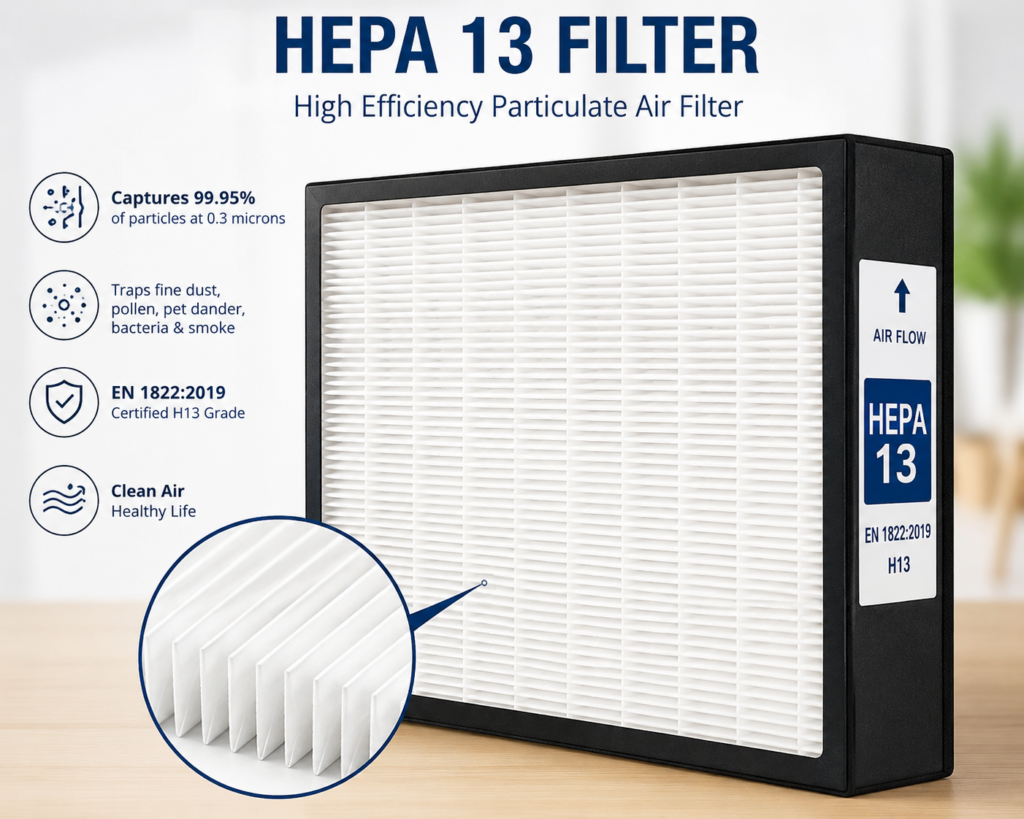
What does "HEPA 13" actually mean?
HEPA stands for High Efficiency Particulate Air. It is a filtration standard, not a brand.
The number 13 refers to a specific grade inside a European classification called EN 1822:2019. This standard sets efficiency levels from H10 to H14, and then moves into ULPA grades U15 to U17.
A certified HEPA 13 filter captures at least 99.95% of particles at 0.3 microns. That size is called the Most Penetrating Particle Size (MPPS), because particles at this exact size are the hardest for any filter to trap. Anything smaller or larger actually gets caught more easily due to airflow physics.
In plain terms: if 10,000 particles at 0.3 microns pass through a HEPA 13 filter, no more than 5 of them get through.
HEPA 13 efficiency explained
Here is why the 0.3 micron benchmark matters. Most airborne particles that affect health sit near this range:
- Fine dust: 0.5 to 10 microns
- Pollen: 10 to 100 microns
- Pet dander: 0.5 to 100 microns
- Bacteria: 0.3 to 10 microns
- Wildfire smoke particles (PM2.5): 0.3 to 2.5 microns
- Some viruses: as small as 0.1 microns (often carried on larger droplets)
A HEPA 13 filter’s efficiency rating at the hardest-to-catch particle size gives you a reliable floor. If it performs at 99.95% at 0.3 microns, it performs better than that at most other sizes.
HEPA 13 vs H11 vs H14 vs "HEPA-type"
This is where confusion usually starts. Not every filter labeled HEPA meets the same bar.
| Grade | Efficiency at 0.3 microns | Typical use |
|---|---|---|
| H10 | 85% | Basic residential filters |
| H11 | 95% | Standard air purifiers |
| H12 | 99.5% | Higher-end purifiers |
| H13 | 99.95% | Medical-grade air purifiers, allergy-focused devices |
| H14 | 99.995% | Hospital operating rooms, cleanroom equipment |
| U15 to U17 (ULPA) | 99.9995% and above | Semiconductor cleanrooms, specialized industrial use |
Two things to watch for:
“HEPA-type” or “HEPA-like” filters are not certified to any EN 1822 grade. They use HEPA in the marketing name without meeting the tested efficiency threshold. These are usually cheaper and less effective. If a product does not list a specific grade (H11, H13, H14) or a certified efficiency percentage, treat the HEPA label with caution.
US labeling rarely uses the EN 1822 H-number system at all. American manufacturers often just say “True HEPA” and reference the older US Department of Energy standard, which requires 99.97% efficiency at 0.3 microns for medical and cleanroom use. That number sits between H13 and H14 on the European scale but is not identically defined. If you see “HEPA 13” on a US-market product, check whether the company cites EN 1822 testing or is borrowing the number loosely. Some brands do this correctly. Some do not.
Is HEPA 13 the same as True HEPA?
Not automatically. “True HEPA” is a US marketing term that generally implies 99.97% efficiency at 0.3 microns, based on DOE testing. HEPA 13 is a specific EN 1822 grade at 99.95% efficiency. The numbers are close but the certification paths differ.
A product can honestly call itself “True HEPA” without being independently tested to the EN 1822 H13 standard, and vice versa. The safest approach: look for the actual test certificate or a stated efficiency percentage, not just the label.
Is HEPA 13 the same as True HEPA?
Not automatically. “True HEPA” is a US marketing term that generally implies 99.97% efficiency at 0.3 microns, based on DOE testing. HEPA 13 is a specific EN 1822 grade at 99.95% efficiency. The numbers are close but the certification paths differ.
A product can honestly call itself “True HEPA” without being independently tested to the EN 1822 H13 standard, and vice versa. The safest approach: look for the actual test certificate or a stated efficiency percentage, not just the label.
What HEPA 13 filters are used for
Air purifiers. This is the most common consumer application. HEPA 13 filters in home air purifiers target allergens, pet dander, dust, and fine particulate matter from smoke or pollution.
Vacuum cleaners. HEPA vacuum filters trap fine dust and allergens that would otherwise get pushed back into the air during vacuuming. This matters most for households with pets, carpets, or allergy sufferers.
Respirators and masks. Some medical and industrial masks reference HEPA-equivalent filtration, though most consumer masks (like N95) use a different testing standard (NIOSH) rather than EN 1822.
HVAC systems. Larger HEPA 13 filters appear in commercial HVAC systems, hospitals, and some high-end residential setups, though most home HVAC systems use MERV ratings instead of HEPA grades.
HEPA vs MERV: how the two scales relate
US HVAC filters are usually rated by MERV (Minimum Efficiency Reporting Value), defined under ASHRAE 52.2, not by the EN 1822 H-number system. The two scales test different things, but this rough comparison helps when shopping for HVAC filters versus standalone purifiers:
| MERV rating | Approximate HEPA equivalent | Common use |
|---|---|---|
| MERV 8 to 10 | Below H10 | Standard residential HVAC |
| MERV 13 | Close to H11 | Higher-end residential and commercial HVAC |
| MERV 16 | Approaches H12 to H13 | Hospitals, labs, high-performance HVAC |
| N/A (HEPA scale only) | H13 to H14 | Standalone air purifiers, cleanrooms, operating rooms |
A whole-home HVAC system rarely reaches true H13 performance because most residential duct systems are not built to handle the airflow resistance of a HEPA-grade filter. This is why H13 filtration is mostly found in standalone air purifiers rather than central HVAC systems. Our HVAC filter guide covers MERV selection for ducted systems in more detail.
Do you need HEPA 13, or is H11 enough?
This depends on why you are filtering the air and whether a HEPA 13 filter matches your actual need.
General dust and everyday air quality: H11 or H12 is usually sufficient. The efficiency difference is small at this level, and H11 filters are typically cheaper and last longer before clogging.
Allergies or asthma: H13 is worth the upgrade. The higher capture rate on fine particles like pollen fragments and pet dander reduces the particles that trigger symptoms.
Wildfire smoke: H13 or higher is recommended. Wildfire smoke particles fall in the 0.3 to 2.5 micron range, right where H13’s certified performance matters most. See our wildfire smoke air purifier guide for room-size and CADR recommendations specific to smoke events.
Pet dander in multi-pet households: H13 helps, especially combined with a pre-filter to catch larger hair and debris before it reaches the HEPA layer.
Immunocompromised individuals or medical settings: H14 is often specified by healthcare guidelines, not H13. If you are filtering air for a medical reason, confirm the requirement with a healthcare provider rather than assuming H13 is sufficient.
For most households dealing with general allergies, H13 hits the point where added cost stops giving meaningful extra protection compared to H14, which is built for cleanroom and hospital environments.
How long does a HEPA 13 filter last?
Most manufacturers recommend replacing a HEPA 13 filter every 6 to 12 months for standard residential use. Several factors shorten that window:
- Homes with pets: replace closer to the 6-month mark
- High pollution or wildfire smoke areas: check filters monthly during smoke season
- Constant, high-hour operation: follow the manufacturer’s filter-life indicator if the device has one
- Visible discoloration or reduced airflow: replace immediately, regardless of the calendar
A clogged HEPA filter does not just filter less. It also reduces airflow, which can strain the device motor and cut down on how much air actually gets cleaned per hour.
How to spot a fake or misleading "HEPA 13" claim
A few checks before buying:
- Look for a stated efficiency percentage (99.95% or higher for a genuine HEPA 13 filter).
- Look for a reference to EN 1822:2019 testing, or DOE testing for True HEPA claims in the US.
- Be cautious of filters that only say “HEPA-type,” “HEPA-like,” or “HEPA-style” without a number or percentage.
- Check the price. Genuine HEPA 13 filters cost more to manufacture. A HEPA 13 claim on an unusually cheap filter is a signal to verify further before buying.
- Check for third-party certification marks or lab test documentation on the product page.
Best HEPA 13 filters by category
Air purifiers: Look for devices that state H13 or True HEPA with a specific percentage, paired with an activated carbon layer if odor removal matters to you. CADR (Clean Air Delivery Rate) should be listed and matched to your room size. Expect to pay 150 to 400 dollars for a mid-size room purifier with a genuine HEPA 13 filter, and 400 to 800 dollars for larger units covering 1,000 square feet or more.
Vacuums: Sealed HEPA systems matter more than the filter grade alone. A vacuum with a HEPA 13 filter but a leaky housing will still release dust back into the room. Check for “sealed HEPA system” in the product description. Vacuums with certified sealed H13 systems typically start around 200 dollars.
Replacement filters: When buying a replacement filter rather than a full device, match the exact model number from the manufacturer. Generic filters marketed as compatible do not always meet the same efficiency grade as the original part. Genuine replacement HEPA 13 filters usually cost 20 to 60 dollars, while unbranded “compatible” filters can run half that price but often skip independent efficiency testing.
Quick buying checklist
Before adding a HEPA 13 filter or air purifier to your cart, confirm:
- The listing states a specific efficiency percentage (99.95% or higher)
- The certification standard is named (EN 1822:2019 or DOE True HEPA)
- The room size or CADR matches your space, if it is an air purifier
- The vacuum specifies a sealed HEPA system, not just a HEPA filter
- Replacement filters match the exact model number of your device
- Return policy covers filter performance, not just physical damage
If a product page is missing three or more of these details, treat the HEPA 13 claim as unverified until you find the missing information.
Frequently asked questions
What does HEPA 13 mean?
A HEPA 13 filter is certified under the EN 1822:2019 standard, capturing at least 99.95% of particles at 0.3 microns.
Is HEPA 13 better than HEPA 11?
Yes. H13 captures 99.95% of particles at 0.3 microns, compared to 95% for H11. The difference matters most for allergy sufferers and fine particulate matter like wildfire smoke.
Is HEPA 13 the same as True HEPA?
Not exactly. True HEPA is a US marketing term generally tied to 99.97% efficiency under DOE testing. HEPA 13 is a specific EN 1822 grade at 99.95%. The two overlap closely but come from different certification standards.
How often should you replace a HEPA 13 filter?
Every 6 to 12 months for standard use, sooner in homes with pets or in areas with heavy smoke or pollution.
Do I need HEPA 14 instead of HEPA 13?
Only if you have a specific medical requirement or are setting up a cleanroom-level environment. For household allergy and dust control, H13 covers most needs.
The bottom line
HEPA 13 is a certified, tested filtration grade, not a vague marketing phrase, as long as the manufacturer actually backs it with EN 1822 or equivalent testing. For most households dealing with allergies, pet dander, or wildfire smoke, it is a solid middle ground between basic filtration and hospital-grade equipment. Check for the stated percentage, confirm the certification, and match the replacement schedule to your actual air quality conditions rather than a fixed calendar date.
Related guides
Sources
- EN 1822:2019, High Efficiency Air Filters (European Committee for Standardization)
- US Department of Energy, HEPA filter definition and testing requirements
- ASHRAE 52.2, Method of Testing General Ventilation Air-Cleaning Devices
- US Environmental Protection Agency, guidance on indoor air quality and particulate matter