
Table of Contents
ToggleAir Filter for Bike: 9 Proven Ways to Improve Engine Performance
Every bike rider knows the basics — change the engine oil, fill quality fuel, keep the tyres inflated. But one component quietly does some of the most important work in your engine, and most riders never think about it until something goes wrong.
The air filter.
Whether you ride a Hero Splendor in city traffic, a Bajaj Pulsar on highways, or a Royal Enfield on long weekend tours, your engine breathes thousands of litres of air every hour. What happens to that air before it enters the engine directly affects your mileage, your pickup, and how long your engine lasts.
This guide covers everything: what a bike air filter actually does, the 9 ways it improves performance, which type suits your riding style, and how to know when it needs replacing.
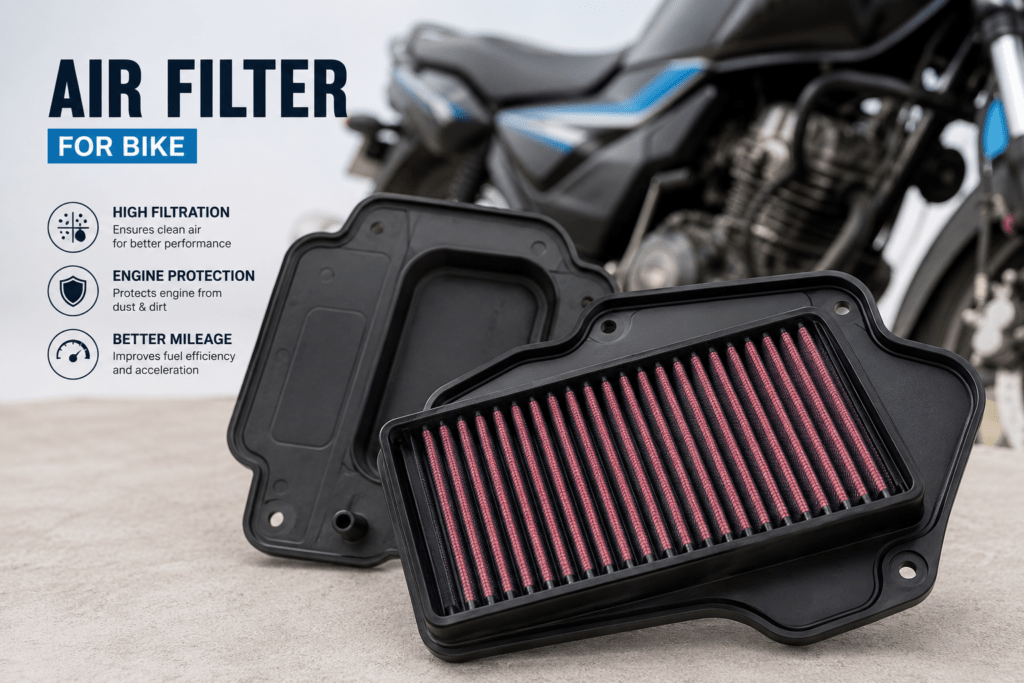
Quick Answer Box
Use of Air Filter in Bike: An air filter cleans the air entering your bike’s engine, blocking dust, dirt, and debris before combustion. Its main job is to protect the engine from damage, improve fuel efficiency, and keep the air-fuel mixture clean for smooth combustion. Riding without one can wear out internal engine parts within minutes.
What Is an Air Filter for Bike?
A bike air filter sits in the air intake system between the outside environment and your engine’s combustion chamber. Its job is simple: let clean air in, keep dirt out.
Every time your engine runs, it pulls in large volumes of air. That air carries dust, sand, pollen, small insects, and microscopic particles — especially if you ride on dirt roads or in dusty Indian cities. Without filtration, these particles enter the engine and slowly damage internal components.
The air filter catches all of that. It allows sufficient airflow for efficient combustion while blocking anything harmful.
How a Motorcycle Air Filter Works
Air enters through the intake, passes through the filter element, and then moves into the carburettor or throttle body where it mixes with fuel. The mixture then goes into the combustion chamber and burns.
A clean filter does this process smoothly. A clogged filter restricts airflow — and that restriction affects everything downstream.
Uses of Air Filter in Bike
An air filter does more than just “filter air.” Here’s exactly what it’s used for and why each function matters to your engine’s health.
1. Engine Protection
This is the filter’s core job — stopping dust, sand, and pollen from entering the combustion chamber. Left unchecked, these particles act like fine sandpaper, gradually scratching piston rings and cylinder walls.
2. Maintaining the Correct Air-Fuel Ratio
Engines need air and fuel in a precise ratio — roughly 14.7:1 for petrol engines — to burn cleanly. The air filter keeps this balance intact, so fuel doesn’t burn incompletely or leave carbon deposits behind.
3. Improving Fuel Efficiency
When air flows freely through a clean filter, the engine doesn’t need to compensate with extra fuel. That translates directly into better mileage — riders often notice a 3-5 km/l drop when the filter is neglected.
4. Sharper Throttle Response
A clogged filter makes the engine feel sluggish, especially on acceleration. A clean one keeps airflow unrestricted, so throttle inputs translate into power almost instantly.
5. Reducing Intake Noise
The filter also regulates how air enters the intake system, which softens engine noise slightly compared to an unfiltered, open intake.
6. Supporting Emission Control
Cleaner combustion means less unburnt fuel escaping through the exhaust — so a well-maintained filter indirectly helps reduce smoke and harmful emissions too.
7. Extending Engine Life
This is the long-term payoff. Less contamination means less wear on pistons, cylinders, and valves — the difference between an engine that runs strong at 60,000 km and one that needs an overhaul.
Why Clean Air Matters for Your Engine
Combustion needs three things: fuel, spark, and air. Remove or reduce any one of them, and the engine runs poorly.
Your engine’s carburettor or fuel injection system is calibrated for a specific air-fuel ratio. For petrol engines, this is roughly 14.7 parts air to 1 part fuel. When airflow drops because the filter is blocked, more fuel burns relative to available oxygen. The mixture becomes “rich” — fuel doesn’t burn completely, carbon deposits build up, mileage drops, and the exhaust smells darker.
This is why a simple filter change can noticeably improve fuel economy on a neglected bike.
9 Proven Ways an Air Filter for Bike Improves Engine Performance
1. Improves Airflow to the Engine
A clean filter allows unrestricted air into the intake. More air means better combustion — the engine gets the oxygen it needs at the right quantity and timing.
On bikes like the Hero Splendor or Honda Shine, which are tuned for efficiency, a partially blocked filter creates a measurable drop in airflow within just a few thousand kilometres in dusty riding conditions.
Replacing a clogged filter restores full airflow immediately.
2. Increases Fuel Efficiency
A dirty filter forces the engine to work harder to pull in air. This leads to richer combustion, incomplete fuel burning, and wasted fuel.
In real-world terms, riders on commuter bikes often report a drop of 3–5 km/l when the air filter is significantly clogged. A fresh filter brings mileage back to the manufacturer’s specification.
For a bike giving 60 km/l, that’s a meaningful difference over a month of daily riding.
3. Enhances Throttle Response and Acceleration
When you twist the throttle, you’re asking the engine for more air-fuel mixture. If the filter restricts airflow, the engine can’t respond as quickly.
This shows up as sluggish pickup from low speeds — a common complaint from Bajaj Pulsar and Yamaha FZ riders who ride in stop-and-go traffic. The engine feels “heavy” or “lazy.”
A clean filter restores sharp throttle response. The engine breathes freely and reacts faster to your input.
4. Protects Internal Engine Components
This is the air filter’s primary function — and the most underrated one.
Dust particles are abrasive. Even particles too small to see can act like fine sandpaper inside your engine, slowly wearing down:
- Piston rings
- Cylinder walls
- Intake valves
- Combustion chamber surfaces
Once these components wear, the damage is permanent. Repair means reboring the cylinder, replacing rings, or in severe cases, replacing the engine. These repairs cost thousands of rupees — far more than the cost of a new air filter every 10,000–15,000 km.
For Royal Enfield riders who take their bikes on long tours through dusty Rajasthan roads or unpaved Himalayan routes, this protection is especially critical.
5. Extends Engine Life
Less contamination inside the engine means less wear. Less wear means longer engine life.
Bikes maintained with regular air filter replacements consistently show cleaner cylinder bores, better compression, and healthier piston rings when inspected. Bikes where the filter was ignored for 30,000–40,000 km often show visible scoring on cylinder walls.
Routine filter maintenance is one of the lowest-cost, highest-impact things you can do for long-term engine health.
6. Reduces Maintenance Costs
Replacing an air filter costs between ₹150 and ₹500 for most Indian bikes, depending on the brand and filter type. Cleaning a foam filter costs even less.
Compare that to:
- Carburettor cleaning: ₹500–₹1,500
- Piston ring replacement: ₹2,000–₹8,000
- Full engine overhaul: ₹10,000–₹30,000+
A neglected filter leads to carbon buildup in the carburettor, fuel system issues, and accelerated engine wear — all of which mean workshop visits and repair bills.
Spending ₹200 on a filter every service interval saves significantly over the life of the bike.
7. Improves Overall Riding Experience
A properly breathing engine feels different. Throttle inputs feel crisp. Power delivery is smooth. The engine pulls cleanly through the rev range without hesitation or hunting at low speeds.
Riders often describe this as the bike feeling “alive” again after a filter change — particularly on older commuter bikes that haven’t been serviced regularly.
If your bike has been feeling slightly off without any obvious mechanical reason, a blocked air filter is a very common cause.
8. Supports Better Mileage in City and Highway Conditions
Efficient combustion — the result of clean airflow — directly translates to better fuel economy under all conditions.
In city traffic, where the engine constantly works at partial load, a clean filter helps maintain the correct air-fuel ratio through frequent acceleration and deceleration cycles.
On highways, where the engine runs at steady load, unrestricted airflow supports more complete combustion and better fuel extraction per litre.
Both conditions improve with a clean filter.
9. Helps Maintain Peak Performance Over Time
Every engine gradually loses its edge when maintenance is skipped. Air filter neglect is one of the most common reasons bikes feel less responsive after 20,000–30,000 km compared to when they were new.
Keeping the filter clean and replacing it on schedule maintains stable engine output. Your 3-year-old Pulsar or Splendor can feel close to its original performance if the intake system is clean and free-flowing.
Types of Air Filters for Bikes
Not all air filters are the same. The type of filter affects filtration efficiency, airflow, service intervals, and cost.
1. Paper / Dry Filter (OEM Standard)
The most common type fitted in factory condition on Hero, Bajaj, Honda, and TVS bikes.
Paper filters use pleated filter paper that traps contaminants as air passes through. They offer good filtration at low cost but cannot be cleaned — only replaced.
Best for: Everyday city riders, commuter bikes Service interval: Replace every 10,000–15,000 km or at every second service Cost: ₹100–₹400 depending on the bike
2. Foam / Sponge Filter
Foam filters are made from open-cell polyurethane foam. They can be cleaned, re-oiled, and reused multiple times, making them economical over the long term.
These are common on older bikes, off-road bikes, and some performance-oriented setups. They require proper cleaning and oiling to work correctly — a dry foam filter offers poor filtration.
Best for: Off-road riders, budget-conscious users, older carburetted bikes Service interval: Clean every 5,000–8,000 km; replace when foam deteriorates Cost: ₹200–₹600
3. Cotton Gauze / High-Flow Filter (Performance Filters)
Brands like K&N make cotton gauze filters that offer higher airflow than paper filters while maintaining good filtration. They are washable and reusable, with a claimed service life of the bike’s lifetime.
These filters can provide a noticeable improvement in throttle response on higher-displacement bikes like Royal Enfield 350/500cc, KTM Duke, and Bajaj Dominar.
Best for: Performance riders, touring bikes, riders wanting better throttle response Service interval: Clean every 30,000–50,000 km Cost: ₹1,500–₹4,000
4. Oil-Bath Filter
Older technology, mostly found on vintage bikes and some agricultural vehicles. Air passes through oil, which traps contaminants. Requires regular oil changes to remain effective.
Best for: Vintage/classic bike owners Mostly found on: Old Rajdoot, Yezdi, early Bullets
Types of Bike Air Filters — Quick Comparison
| Filter Type | Filtration | Airflow | Lifespan | Cleanable | Best For | Approx. Cost |
|---|---|---|---|---|---|---|
| Paper Filter | High | Standard | Single-use | No | Daily city riders | ₹100–₹500 |
| Foam Filter | Medium | Good | Reusable | Yes | Off-road, budget riders | ₹200–₹600 |
| Cotton Gauze | High | High | Long-term | Yes | Performance bikes, touring | ₹1,500–₹4,000 |
| Oil-Bath | Medium | Standard | Long | Yes (oil change) | Vintage bikes | Varies |
For most Indian riders, the paper filter is the right choice for daily use. If you ride off-road or on unpaved roads regularly, foam works better. Cotton gauze filters make sense for Royal Enfield, KTM, and Dominar owners who want better airflow without compromising filtration.
How to Tell If Your Air Filter Needs Replacement
Your bike gives clear signals when the air filter is overdue.
Drop in fuel efficiency: If your regular 50–60 km/l bike suddenly starts giving 45 km/l or less without any other change, the filter is a likely cause.
Sluggish acceleration: The engine feels hesitant, especially from 0–40 km/h. Throttle response feels delayed.
Black or sooty exhaust: Dark exhaust smoke indicates a rich mixture — too much fuel relative to air. A blocked filter is a common cause.
Engine running rough at idle: The bike hunts or stutters at traffic lights rather than idling smoothly.
Visible dirt on the filter: When you remove and inspect the filter, visible grey or brown discolouration across the filter surface means it’s time to replace.
Difficulty starting: A severely blocked filter can make starting harder, particularly in cold morning conditions.
How to Clean a Foam Air Filter at Home
If your bike uses a foam filter, you can clean it yourself in under 20 minutes.
What you need:
- Kerosene or filter cleaning solution
- Clean engine oil or filter oil
- Two clean rags
- Flat screwdriver (to open the airbox)
Steps:
- Locate the airbox — usually behind or below the seat, connected to the carburettor or throttle body via a rubber intake hose.
- Remove the airbox cover (usually 2–4 screws or clips).
- Pull out the foam filter element carefully.
- Inspect it. If it’s torn, hardened, or crumbling, replace it rather than cleaning.
- Soak the foam in kerosene and gently squeeze — don’t twist or wring it. The dirt will come out with the kerosene.
- Rinse with clean kerosene until the liquid runs clear.
- Allow to dry completely — at least 2–3 hours. Never install a wet filter.
- Apply a thin, even coat of clean engine oil to the entire foam surface. Squeeze out excess oil gently.
- Reinstall the filter and secure the airbox cover.
Do not: Use petrol to clean the filter (it degrades foam), compress the foam aggressively, or install before it’s fully dry.
Paper filters cannot be cleaned this way — tapping them to remove surface dust is acceptable in the short term, but replacement is the correct solution.
When to Replace Your Bike's Air Filter
As a general rule:
| Bike Type | Riding Condition | Replacement Interval |
|---|---|---|
| Commuter (Splendor, Shine, Activa) | City roads | Every 10,000 km |
| Commuter | Dusty/rural roads | Every 6,000–8,000 km |
| Sport (Pulsar, FZ, Apache) | Mixed conditions | Every 10,000–12,000 km |
| Touring (Royal Enfield, Dominar) | Highway + rural | Every 10,000–15,000 km |
| Off-road / Dirt roads | Any | Every 3,000–5,000 km |
These are guidelines. If you ride through heavy construction dust, unpaved roads, or sandy terrain regularly, inspect the filter more frequently regardless of kilometre count.
A quick visual check takes 5 minutes and tells you far more than any fixed schedule.
OEM vs Aftermarket Air Filter: Which Is Better?
OEM (Original Equipment Manufacturer) filters — supplied by Hero, Bajaj, Honda, TVS — are calibrated for your specific engine’s air-fuel requirements. They offer reliable filtration and are the safest choice for warranty compliance and fuel efficiency.
Aftermarket standard filters — budget replacements available at local spare parts shops — vary significantly in quality. Some are good; some use inferior filter media that allow more particles through. Buy from reputable brands or authorised dealers.
Performance aftermarket filters (K&N, BMC) — offer higher airflow and reusability. Best suited for riders who want improved throttle response and are comfortable with the higher upfront cost. These work best on modified or higher-displacement bikes where airflow is genuinely a limiting factor.
For most commuter riders on Hero or Honda bikes, the OEM filter is the right choice. For Royal Enfield and performance bike riders who want better breathing, a quality aftermarket motorcycle air filter — cotton gauze type — is worth considering.
Air Filter and Carburetor: The Connection
On carburetted bikes — which includes most Indian commuter bikes — the air filter and carburettor work closely together.
A restricted filter causes the carburettor to pull harder to draw air through. This creates a slightly richer mixture than intended. Over time, this leads to:
- Carbon deposits on the carburettor jets and needle
- Fuel residue in the float chamber
- Gradual decline in idle quality
Regular air filter maintenance directly reduces how often the carburettor needs cleaning. Bikes with consistently clean filters often go 2–3 times longer between carburettor services compared to bikes where the filter is neglected.
This is particularly true for older carburetted bikes. A clogged motorcycle air filter and a dirty carburettor often create problems together — fix one, and the other improves too.
Frequently Asked Questions
Q: Can I ride without an air filter temporarily?
No. Even a short ride without a filter allows abrasive particles to enter the engine. Cylinder wall damage can occur within minutes in dusty conditions. Never ride without the filter installed.
Q: Will a performance air filter increase my bike’s power?
On stock commuter bikes, the air filter is rarely the limiting factor for power. You may notice slightly improved throttle response, but significant power gains require changes to other components too. On larger bikes, a high-flow filter can support a small but real improvement.
Q: My bike is new — does the air filter still need checking?
Yes. Riding conditions matter more than bike age. A new bike ridden on construction-heavy city roads or dusty highways can clog a filter faster than an older bike used purely on good roads.
Does Air Filter Affect Mileage in a Bike?
Yes — a dirty or clogged air filter directly reduces mileage. When airflow is restricted, the engine burns extra fuel to compensate, often dropping mileage by 3-5 km/l. Replacing or cleaning the filter typically restores mileage to normal within the next few rides.
Q: Is it okay to tap/blow air through the paper filter to extend its life?
Tapping removes loose surface dust and is acceptable as a short-term measure between services. Blowing compressed air through a paper filter can damage the filter media. Neither substitutes for replacement.
Q: What is the main use of an air filter in a bike?
Its primary job is protecting the engine from dust and dirt while allowing clean air into the combustion chamber — this keeps the engine running efficiently and prevents premature wear.
Q: What happens if the air filter goes bad?
A clogged or dirty filter causes reduced mileage, sluggish acceleration, black exhaust smoke, and sometimes difficulty starting the bike, especially in colder conditions.
Q: How many types of air filters are there?
There are four main types — paper (dry), foam, cotton gauze (performance), and oil-bath filters. Each differs in filtration efficiency, airflow, and how often it needs servicing.
Q: Can I clean or replace the air filter myself?
Yes. Foam filters can be cleaned at home using kerosene and re-oiled for reuse. Paper filters can’t be cleaned the same way — they need straightforward replacement, which most riders can do without a mechanic.
Final Thoughts
The air filter is one of the simplest, cheapest, and most impactful maintenance items on any bike. It protects expensive internal components, maintains fuel efficiency, and keeps the engine running the way it was designed to.
For Indian riders dealing with dusty city roads, construction zones, rural tracks, and long highway tours — conditions that are genuinely hard on air filtration — regular filter inspection and timely replacement is not optional. It’s basic bike care.
Choosing the right motorcycle air filter for your riding style matters too. A paper filter for city commuting, foam for off-road, cotton gauze for touring and performance — the right choice keeps your engine protected and running efficiently.
Check it at every service. Replace it on schedule. Your engine will last longer, your mileage will stay consistent, and the bike will simply feel better to ride.
Request a Free Quote Today
Contact Our Filtration Experts
Use of air filter in bike
Lorem ipsum dolor sit amet, consectetur adipiscing elit. Ut elit tellus, luctus nec ullamcorper mattis, pulvinar dapibus leo.