
Table of Contents
ToggleCar Oil Filter Guide: Improve Engine Performance & Protection
Your engine runs on oil. That oil picks up metal shavings, dirt, carbon deposits, and combustion byproducts every time you drive. Without a car oil filter, all of that contamination circulates through your engine continuously — wearing down bearings, clogging passages, and shortening engine life.
A car oil filter is one of the smallest and least expensive components in your vehicle. It’s also one of the most important. This guide explains how oil filters work, what types are available, how to choose the right one, when to replace it, and what happens if you don’t.
What Is a Car Oil Filter?
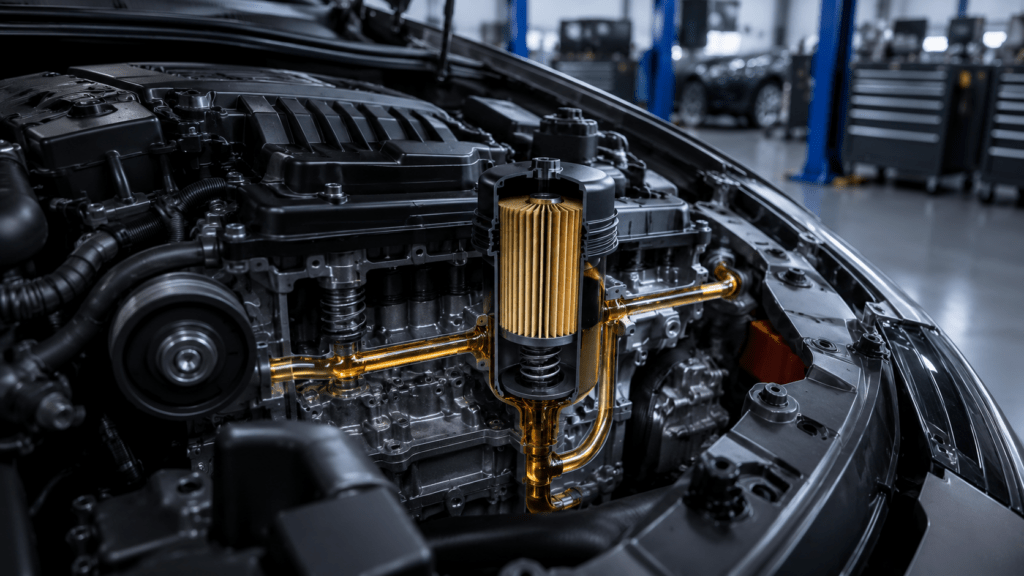
A car oil filter is a mechanical filtration device installed in the engine’s lubrication system. Its job is to remove contaminants from engine oil before that oil circulates through critical engine components.
Engine oil lubricates moving parts — pistons, crankshaft bearings, camshafts, valve train components — and reduces friction between metal surfaces. As it does this, it collects particles. Metal wear debris, dirt that enters through the air intake, carbon from combustion, and oxidation byproducts all end up in the oil.
The oil filter catches these particles before they cause damage. Without it, contaminated oil acts like a fine abrasive, grinding away engine components with every revolution.
How Does a Car Oil Filter Work?
The engine oil pump pushes oil from the sump through the oil filter before it reaches engine components. As oil passes through the filter media — typically pleated paper, synthetic fiber, or a combination — particles are trapped and clean oil continues through the system.
Most car oil filters also include two additional components:
Anti-drainback valve — This rubber valve prevents oil from draining back into the sump when the engine is off. Without it, there’s a brief moment of dry running when you start the engine, because the oil passages are empty and the pump takes a second to build pressure. The anti-drainback valve keeps oil in the filter and passages, so lubrication is immediate on startup.
Bypass valve — If the filter becomes severely clogged, oil pressure builds up behind it. The bypass valve opens at a set pressure (typically 10–15 psi) and allows unfiltered oil to flow through rather than starving the engine of lubrication. An engine running on dirty oil is better than an engine running on no oil.
These two valves are why filter quality matters. Cheap filters sometimes use low-quality valve materials that fail early or don’t seal properly.
Types of Car Oil Filters
ocySpin-On Oil Filters
The most common type on the road today. A spin-on filter is a self-contained unit — the filter media, housing, anti-drainback valve, and bypass valve are all built into one metal canister that threads directly onto the engine block.
They’re easy to replace, widely available, and compatible with most passenger vehicles. The downside is that the entire metal housing is discarded at every oil change, which generates more waste than cartridge-style filters.
Cartridge Oil Filters
Cartridge filters use a replaceable filter element that fits inside a permanent housing mounted on the engine. You open the housing, remove the old cartridge, install a new one, and reassemble.
They’re becoming more common in modern vehicles — especially European brands — because they generate less waste (only the filter element is discarded) and allow easier inspection of the filter condition.
The tradeoff is that cartridge housings can develop seal or O-ring issues over time, and replacement is slightly more involved than a spin-on.
High-Performance Oil Filters
High-performance car oil filters use finer filter media, higher-capacity construction, and stronger bypass valves for engines operating under demanding conditions — track use, towing, extended drain intervals, or turbocharged applications.
They typically offer higher particle capture rates (capturing particles down to 15–20 microns versus 25–40 microns for standard filters) and greater dirt-holding capacity before bypass.
If your vehicle operates under standard conditions and you change oil regularly, a quality standard filter is adequate. High-performance filters add value in high-stress applications.
Extended Life Oil Filters
Extended life filters are designed to last longer between changes — typically aligned with synthetic oil drain intervals of 7,500 to 10,000 miles or more. They use higher-capacity media and more durable construction.
If you use full synthetic oil and follow extended drain intervals, an extended life filter is the correct match. Using a standard filter with extended-interval synthetic oil means the filter may clog before the oil needs changing.
Magnetic Oil Filters
Magnetic filters add a magnetic element to capture ferrous metal particles that fiber media can’t always trap. They’re more common in motorcycles and performance applications than everyday passenger cars.
Some mechanics add a magnetic drain plug alongside a standard oil filter for similar benefits at low cost.
Why the Car Oil Filter Matters for Engine Performance
Removes Abrasive Particles
Metal wear particles as small as 10–40 microns are invisible to the eye but abrasive enough to accelerate bearing and cylinder wall wear. A functioning oil filter removes these particles continuously, keeping oil cleaner between changes.
A study of engine wear patterns consistently shows that vehicles with regular oil and filter changes have significantly lower wear metal concentrations in their oil — directly translating to longer engine life.
Maintains Oil Viscosity
Contamination thickens oil and changes its viscosity. Thick, contaminated oil doesn’t flow as easily through narrow oil passages, reducing lubrication at critical surfaces. A clean filter keeps contamination levels low and helps oil maintain its designed viscosity grade.
Protects Engine Bearings
Engine bearings — the components that allow the crankshaft and connecting rods to rotate — depend on a thin film of pressurized oil for protection. Contaminated oil with abrasive particles damages this film and accelerates bearing wear. Bearing failure is one of the most expensive engine repairs.
Regular oil filter replacement is one of the lowest-cost ways to protect against this.
Supports Efficient Combustion
Clean oil reduces internal friction. Lower friction means the engine uses less energy moving its own components and more energy moving the vehicle. In real-world terms, clean oil and a fresh filter contribute to the fuel efficiency your engine was designed to deliver.
Real-World Examples
High-mileage vehicle: A 2012 sedan at 140,000 km with inconsistent oil change history showed elevated iron particles in an oil analysis — a sign of accelerated bearing wear. After switching to a high-quality oil filter and strict 5,000 km change intervals using full synthetic oil, subsequent oil analysis showed a significant reduction in wear metals over the next three changes. No engine work was required.
Turbocharged engine: Turbos spin at up to 150,000 RPM and are directly lubricated by engine oil. A clogged or poor-quality oil filter starves the turbo’s journal bearings of clean oil. One of the most common causes of premature turbo failure is extended oil change intervals with inadequate filtration. Using an extended life high-performance filter matched to synthetic oil intervals is standard practice for turbocharged vehicles.
Fleet vehicles: A logistics company running 40 delivery vans switched from the cheapest available oil filters to a quality branded filter at slightly higher cost. Over 12 months, engine-related maintenance incidents dropped and average engine life between overhauls extended — the filter cost difference was negligible compared to the repair savings.
How to Choose the Right Car Oil Filter
Check Vehicle Compatibility First
Every engine has specific oil filter specifications — thread size, filter dimensions, bypass valve pressure rating, and anti-drainback valve requirement. The wrong filter may physically fit but have an incorrect bypass pressure setting or missing anti-drainback valve.
Use your vehicle’s make, model, year, and engine size to identify compatible filters. Most filter manufacturers provide cross-reference guides for this.
Match the Filter to Your Oil Type and Drain Interval
| Oil Type | Recommended Filter |
|---|---|
| Conventional oil, 3,000–5,000 km intervals | Standard spin-on filter |
| Synthetic blend, 5,000–7,500 km intervals | Quality standard or extended filter |
| Full synthetic, 7,500–10,000+ km intervals | Extended life filter |
| High-performance / turbocharged engine | High-performance filter |
Using a standard filter with full synthetic oil on a 10,000 km interval is a common mistake. The filter media saturates before the oil needs changing, and the bypass valve opens — meaning unfiltered oil circulates for the remainder of the interval.
Evaluate Filter Media Quality
Filter media is rated by micron rating (particle size captured) and efficiency (percentage of particles at that size captured). A filter rated at 20 microns at 98.7% efficiency captures 98.7% of particles 20 microns and larger.
Cheap filters often use lower-grade cellulose media with inconsistent pore sizes. Quality filters use synthetic or blended media with tighter manufacturing tolerances. This difference isn’t visible from the outside — it’s in the filter’s specifications.
Don’t Buy Solely on Price
The price difference between a budget oil filter and a quality one is typically small — often less than the cost of a cup of coffee. The cost difference between a failed engine bearing and regular filter replacement is not small.
Brand names with established testing data and consistent quality control — such as Bosch, Mann, Mahle, WIX, and Fram (their higher-tier lines) — are worth the marginal price difference over generic alternatives.
Car Oil Filter vs. No Filter (What Actually Happens)
Some older vehicles and small engines run without an oil filter, relying on the oil sump to settle contaminants. Modern car engines operate at much higher tolerances — clearances between moving parts are measured in microns, not millimeters. At these tolerances, even small particles cause measurable wear.
An engine running without an oil filter, or with a severely clogged one in bypass mode, will show accelerated wear within tens of thousands of kilometers — often much sooner under hard use. Oil analysis of bypass-condition engines consistently shows elevated wear metals.
The filter is not optional equipment. It’s part of the lubrication system design.
How to Check Your Car Oil Filter Condition
You can’t see inside a spin-on filter without cutting it open, but these indicators tell you when replacement is due:
Mileage or time interval — The most reliable guide. Replace the oil filter every time you change the oil. Don’t reuse an old filter with new oil.
Oil pressure warning light — A clogged filter in bypass mode may trigger low oil pressure warnings in some vehicles. Don’t ignore this.
Oil color and consistency — Dark, thick oil at the dipstick that smells burned suggests contamination has built up. The filter is likely saturated.
Oil analysis — For high-value vehicles or engines under warranty, periodic oil analysis (sending a sample to a lab) gives direct data on wear metals, contamination levels, and oil condition. It tells you exactly what’s happening inside the engine.
When to Replace a Car Oil Filter
Standard rule: Replace the oil filter at every oil change. The filter and oil are one system — changing the oil while leaving the old filter installed means contaminated filter media immediately re-contaminates the new oil.
Extended synthetic intervals: Use an extended life filter rated for the same interval as your synthetic oil. A standard filter on a 10,000 km synthetic interval will go into bypass well before the oil change is due.
After engine work: Any time the engine has been opened for repairs — especially work involving bearings, gaskets, or internal components — change the oil and filter immediately after the work is complete, then again after a short run-in period (500–1,000 km). Debris from machining and assembly enters the oil and needs to be flushed out.
After overheating: Overheating degrades oil rapidly. If the engine has run hot, change the oil and filter before continuing normal operation.
Car Oil Filter Maintenance: Step-by-Step
Replacing a spin-on oil filter is a straightforward job that most vehicle owners can do at home.
What you need:
- Correct replacement oil filter (check compatibility)
- Oil filter wrench (for removal)
- Drain pan
- New engine oil
- Rags or shop towels
Steps:
- Warm the engine for 2–3 minutes, then shut it off. Warm oil drains faster and carries more contaminants with it.
- Place the drain pan under the oil drain plug and remove the plug. Let the oil drain fully — allow 5–10 minutes.
- Locate the oil filter. On most engines it’s accessible from underneath or the side of the engine block.
- Use the oil filter wrench to loosen the old filter counterclockwise. Finish removing by hand — oil will spill, so have a rag ready.
- Before installing the new filter, apply a thin film of fresh oil to the new filter’s rubber gasket. This prevents the gasket from sticking and ensures a proper seal.
- Thread the new filter on by hand until the gasket contacts the engine, then tighten by hand an additional half turn. Don’t use a wrench to tighten — over-tightening damages the gasket.
- Replace the drain plug with a new washer if required.
- Add new oil through the fill cap, check the level on the dipstick, and start the engine.
- Check for leaks around the filter and drain plug. Shut off and recheck the oil level after 1–2 minutes of running.
Cartridge filter replacement follows a similar process but requires opening the filter housing and replacing only the internal element.
Frequently Asked Questions
How often should I change my car oil filter? Change it at every oil change. The filter and oil work as one system. Reusing an old filter with new oil defeats the purpose of the oil change.
Can I change just the oil filter without changing the oil? Technically yes, but there’s no benefit. The old oil is already contaminated. Change both together.
What happens if I use the wrong oil filter? A filter with the wrong thread size won’t seal. A filter with the wrong bypass pressure may open too early or too late. A filter without an anti-drainback valve causes dry startups. Always verify compatibility before installing.
Are expensive oil filters worth it? The price difference between a budget and quality filter is small. Quality filters use better media, better valves, and more consistent manufacturing. For the cost difference, the added protection is worth it.
Can a clogged oil filter damage the engine? Yes. A severely clogged filter forces the bypass valve open, allowing unfiltered oil to circulate. Extended operation in bypass mode accelerates wear on bearings and other critical components.
How do I know if my oil filter is clogged? You generally won’t know without oil analysis or cutting open the filter. This is why changing the filter on schedule — not waiting for symptoms — is the right approach.
Conclusion
A car oil filter does one job: keep your engine oil clean enough to protect the components it lubricates. It costs a few hundred rupees and takes minutes to replace. The engine it protects costs lakhs.
Change your oil filter at every oil change. Match the filter type to your oil grade and drain interval. Use a quality filter from a reputable manufacturer. These three habits alone prevent a significant share of premature engine wear.
If you’re unsure which filter is right for your vehicle, use the manufacturer’s part number as a reference and cross-check with a trusted brand’s fitment guide. The right filter, changed on schedule, is one of the best investments you can make in your vehicle’s long-term reliability.